Some of the nuke types over on Twitter have been discussing this. It would have beaten Sputnik to space, but not to earth orbit.
Category Archives: Space
XCOR
…has a new board. Greason, Fleming (whose name they misspelled) are out. They say “as the Lynx nears completion,” but I wonder about that.
The Atlas V
…dodged a bullet on the Cygnus launch last week. If it had been a mission failure, it would have been its first.
Europa With Falcon Heavy
I was running some numbers, and just got a surprising result. I’m wondering if someone can check my work.
The AIAA paper by Boeing, presented in Pasadena last fall, has a reference mission of 8.3 MT thrown at Jupiter for the fast trip with no gravity assists with the Block 2 cargo version. They specify a C3 of about 85 km^2/s^2. Here’s the table I’m looking at.
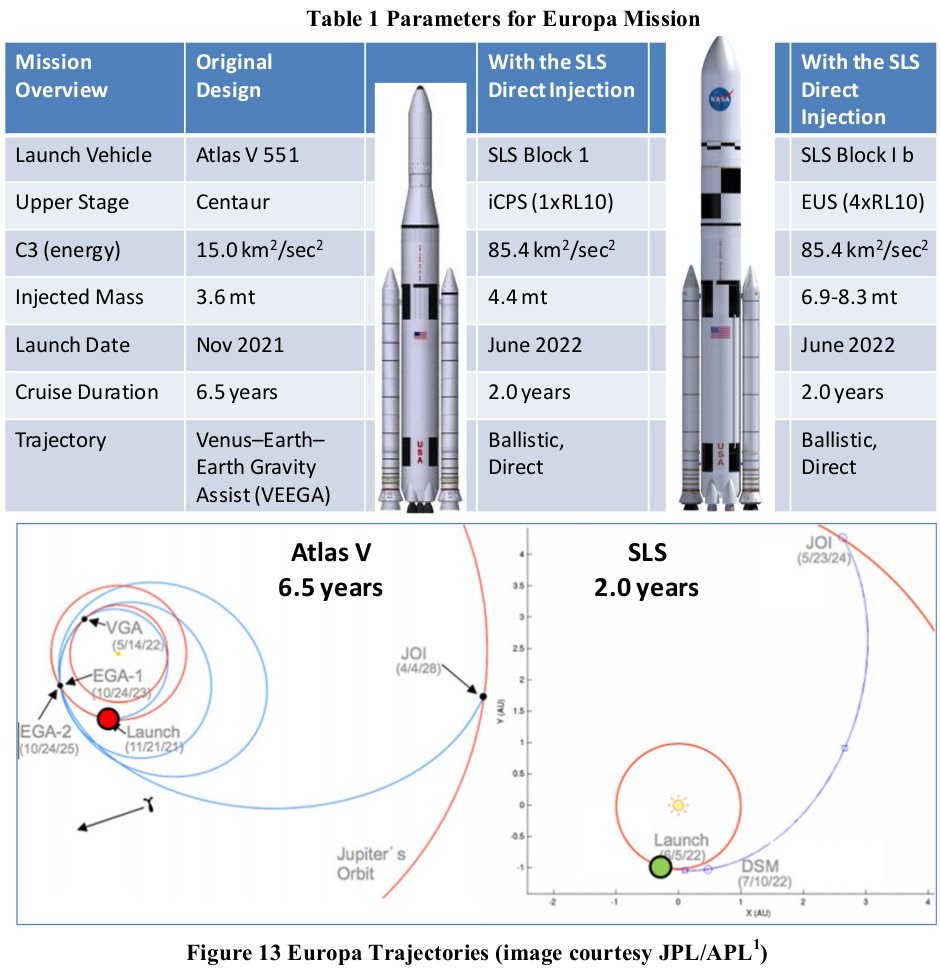
When I back that out, I end up with a departure velocity from LEO of about 6.5 km/s. With a stage fraction of 0.1 (that is, the ratio of the stage dry weight to loaded weight) and an Isp of 465 (referencing RL-10), and sixty tonnes in LEO (that’s the latest I’m hearing for FH with the upgraded cores), I can do that mission with a single flight. If we do two flights, I can throw 24 MT. Here’s my spreadsheet. Am I getting something wrong? Because that implies that they could do an even bigger mission with a 130 MT SLS. Here’s my spreadsheet.
[Update a few minutes later]
OK, I do see one slight problem, but I don’t think it affects my results much. I sized the “rubber” stage to the 2nd-stage requirement, so it’s probably a little undersized for the first stage. That is, when I change the payload mass, I get a slightly different propellant load in the first stage, though in actuality it should be independent of that.
[Update a few minutes later]
I’m wondering if the problem they have is that the EUS is oversized for the mission, so it wastes a lot of propellant shoving the parasitic stage mass? If so, that would be kind of hilarious.
But it is also possible that I’ve done the calculation wrong, which is why I’d like more eyes on my work.
[Update a couple minutes later]
D’oh!!
I do see an error. I double the potential energy as well as the kinetic when solving for departure velocity in line 13. BRB.
[Update a few minutes later]
OK, I guess I was wrong when I said I was wrong. Still not seeing the problem, if there is one.
[Update a while later]
I should note that the numbers don’t look obviously wrong, or bother me intuitively. I’m just trying to understand the disparity with the SLS mission, which supposedly has twice the throw weight.
[Late-afternoon update]
Looking at the Wikipedia page for EUS (I know, but it’s usually not a bad source for things like this), mass properties are pretty scarce. All it says is that it can carry 129,000 MT of propellant, which makes no sense, since that’s the throw weight of the SLS, and leaves no margin for structure. So huh. It’s almost like the whole program is a Bravo Sierra jobs program.
[March 28th update]
I just had an email exchange with one of the paper’s authors. They are using the Block 1B configuration, which only has 105 tonne capability. So my numbers seem to be right.
[Bumped]
Mojave
The Economist pays a visit.
Space Property Rights
A (relatively) new paper. If the space-settlement bill has hearings and is discussed on the floor, this will become a key issue.
STS-93
A rocket-geek recollection on stoichiometry and flight-propellant reserve from Wayne Hale. The other day he tweeted that he’d been looking through his old files from Shuttle days and was wondering if there’d be a market for a book. I think there would be.
An SLS “Explainer”
This is very disappointing, from Popular Mechanics. A real “explainer” would explain why SLS is not in fact going to get astronauts to Mars, and why “power” is not the most important figure of merit for a rocket. Instead, they just regurgitate BS from NASA.
Heading To DC
I’m in the air somewhere over Wyoming on the way to ORD to switch planes for a flight to DCA this afternoon. Attending a workshop on space safety tomorrow. I’ve got Internet, obviously, but what I don’t have is room to type comfortably, given the seat pitch and guy ahead of me reclining. So probably light posting.
The SEDS Act
Dana has been talking about this for a year, but he’s finally introduced it:
To require the National Aeronautics and Space Administration to investigate and promote the exploration and development of space leading to human settlements beyond Earth, and for other purposes.
Development and settlement demand low cost of access to space, while NASA is forced by Congress to pursue a giant rocket that has exactly the opposite effect. I wish they’d left the E word out, because that’s implicit, and it allows people to maintain the status quo: “Well, the first thing we have to do is exploration, before we can think about development and settlement. And we can’t do exploration without SLS!”
I have a query in to Tony DeTora as to how this differs from the 1989 bill, because I still see no teeth in it regarding what to do if the administrator ignores it and doesn’t submit reports.
[Update a while later]
Related: A new book of essays and stories on the spiritual aspects of space