From Clark Lindsey, and from John Carmack himself:
There isn
From Clark Lindsey, and from John Carmack himself:
There isn
Andrew Smith is worried about “plundering the moon.”
It’s a theme that I’ve discussed (and shot down) in the past. And read the comments section in his Guardian piece–it’s chock full of anthrophobic moon battery.
Wretchard comments:
Today, for the first time in human history, man can look forward to spreading into truly virgin territory. To go where no man has ever gone before; and consequently where no man ever need be displaced from his abode. The words “we come in peace for all mankind” may have fallen unheard upon the lunar rocks. But the words still have meaning to a mankind trapped not only upon Earth but within his history. If Marxism was a project to bring History to an end in the near future, Environmentalism is an attempt to freeze History in the distant past. Not for the benefit of mankind, nor even when you come to think of it, for Nature — unless man is excluded from the account — but for the sake of having the power to end history on their terms.
They will not succeed and man will go on. No less than the trees and stars we have a right to be here.
Speaking of Marx, here’s an interesting theory on how he came up with such an inhuman philosophy:
Sam Shuster, professor of dermatology at the University of East Anglia, believes the revolutionary thinker had hidradenitis suppurativa (HS) in which the apocrine sweat glands — found mainly in the armpits and groin — become blocked and inflamed.
“In addition to reducing his ability to work, which contributed to his depressing poverty, hidradenitis greatly reduced his self-esteem,” said Shuster, who published his findings in the British Journal of Dermatology.
“This explains his self-loathing and alienation, a response reflected by the alienation Marx developed in his writing.”
Of course, it doesn’t explain why so many less dermatologically challenged people bought (and continue to buy) into it.
[Via Thomas James, who has some additional thoughts]
EADS repeated that it is hoping to close funding for a suborbital rocket in early 2008. I’ve decided I wasn’t harsh enough with my last post. For $1.3 billion, one could probably buy at least seven of the following companies: Rocketplane, XCOR, The Space Ship Company, Armadillo Aerospace, Masten Space Systems, Benson, TGV and Blue Origin. That would leave enough money to send all their suborbital vehicle programs through test flights. One might even be able to use the left over money to also pick up Virgin Galactic, Incredible Adventures and Space Adventures. If you are funding the EADS suborbital rocket, consider putting out an RFP instead. Even if you are a government. You might get seven to ten local new space companies with more than one successfully entering a viable vehicle into commercial service for the price of one old-space program.
See previous post.
We’re expecting a statement from Brett Alexander of the X-Prize Foundation shortly.
[A few minutes later]
Brett has arrived.
No injuries or fatalities, so safety was good. John Carmack: “Today was officially a bad day.” John could have made a Level 2 attempt but chose not to. Couldn’t do it tomorrow because no insurance–Cup over. Doesn’t know what happened, other than explosion at ignition. Quite violent, not just a crack. Fire on the pad, cabling disconnected, called Level II Safety Emergency. Wanted fire trucks, etc., but were able to approach and safe vehicle. Went out on its own after LOX ran out, though still some ethanol in the vehicle. Doesn’t know what their plans are other than to return to the hangar.
How close are other contenders? None of them have done an untethered flight, but he expects that next year there will be more than one team competing, and the two million still on the table will provide an incentive. Considers weekend a success. Two successful flight attempts, and a good long flight even with a cracked chamber. Demonstrated safety and abort ability. Static displays showed a lot of innovation, and hope for future. NASA hasn’t put out any money yet, but has gotten many many times the two million in effort, and ultimately this will still provide technology for lunar landers. Had 6000 students here on Friday, and this is about education and inspiration. Preliminary number is 80,000 people here on the weekend. Expected only 60,000. Only had 15,000 last year for the Cup alone.
Doesn’t know what will happen next year. LLC doesn’t have to be at a show. Would be much cheaper to do it without public for safety reason. Northrop Grumman was only committed for two years, but are pleased with results to date, despite lack of win. No commitment yet. Wirefly having financial difficulties of their own, so doesn’t think their pull out of sponsorship has anything to do with Cup.
Thinks that merging of aviation and space is “fantastic.” Makes a good combination.
Can change rules next year, but has no plans to. Not sure how to do concurrent ops or schedule with more contenders. Only two slots are required–if there had been a competitor, they would have gotten the other two.
Vehicle not totally destroyed, still standing up, tanks looked intact. Has no particular insight.
Apparently the hard starts have only been occurring on the return leg. The current theory is that it’s due to a change in the injector design. Jeff Foust has the details.
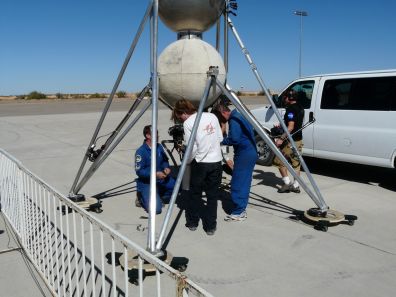
Phil Eaton and two other Armadillo staff are removing the engine from the spare Mod.
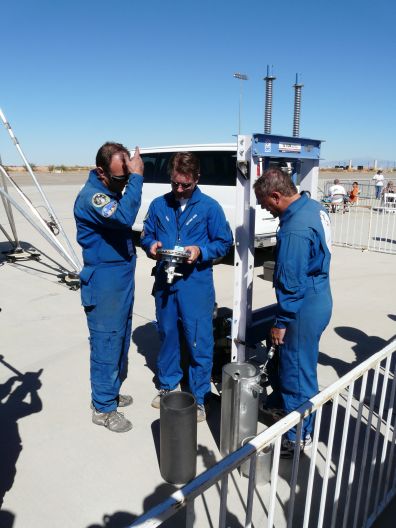
I think that they’re looking over the injector they just pulled to check it out before installing it into the flight vehicle. Phil Eaton on the left, Matthew Ross in the middle, not sure who’s on the right.
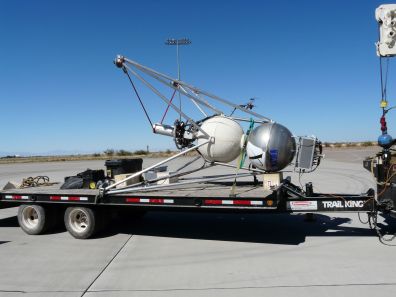
Here’s a modified “Mod” ready to try again.
As I type this, I think they’re heading back out to the launch site for another attempt in forty-five minutes or so. I’ll be heading back out there shortly. Hopefully I’ll be back with pics of a successful flight.
[Update about 2:30 PM MDT]
Well, you may have heard, but there will be no winner this year. All the money remains on the table. I think that’s a good thing, actually, because there are a lot of competitors out here who look almost ready to compete, and in another year many of them should be able to.
The post briefing hasn’t occurred yet. All I know was that when the ignition was supposed to occur, I only heard a bang, followed shortly after by an announcement of a declaration of emergency to put out a fire. Apparently it was yet another hard start, and it ended Armadillo’s chances for a win this year.
Neil Milburn reportedly stated at an 11 AM briefing that prior to this weekend, they had never turned the vehicle around in the time necessary to win the prize, which kind of blows my mind. All this time I had been hearing that they were confident because they had flown the profile many times, but apparently that didn’t mean that they had flown the full profile, which requires a return in a fixed time period.
Well, lessons learned. Good luck to them (and all the others) next year.
I’m back at Holloman, almost half past eight in the morning. In theory, Armadillo should have headed out to the pad for another attempt about half an hour ago, and will try again at nine or so. I’m heading out there now to see if that’s the case, and if so, I’ll get some pictures.
[Update at 10 AM]
Scrubbed again. The first flight was successful, except it had another hard start. On the return attempt, it lit, lifted off for a few seconds, then aborted and sat back down. They performed some analysis for a few minutes, then announced that they weren’t going to attempt to fly again until they returned the vehicle and did some work on it. The current word is that they had another hard start and some anomalous pops, and decided to abort. Alan Boyle has more.
I just talked to Ken Davidian, who is in charge of NASA’s Centennial Challenges (where the prize money comes from), and he told me that it looked as though they were going to give Armadillo two more attempt windows today, one this afternoon (like yesterday) and one after the show ends at five or so.
I have to drive up to Albuquerque tonight for a flight back to Florida early in the morning, and was hoping to do it in daylight (because I’ve never done the route from Alamagordo), so I hope that they can nail it this afternoon.
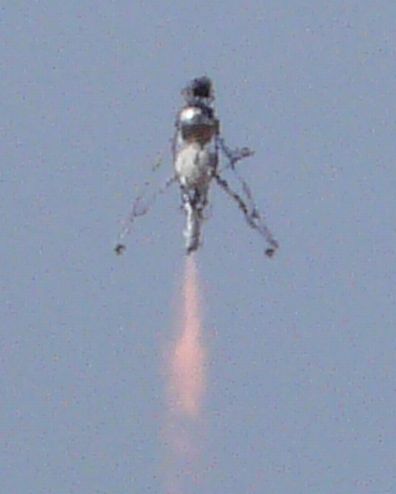
I missed the first flight, but it was successful. The second one was beautiful right up until the end, when the burn seemed to end prematurely, and the vehicle reportedly fell over on landing. It was difficult to see, because it was obscured by all the dust kicked up from the long hover. More pics in a few minutes.
[A few minutes later]
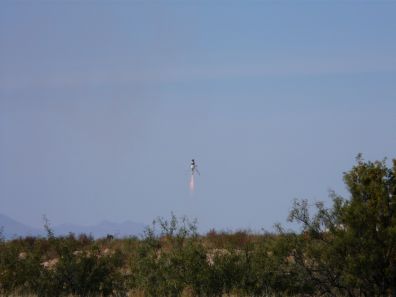
The above is the long shot from which the top picture was digitally zoomed (I took it with an 18x optical lens, 504mm equivalent).
Below is a picture of all the dust being kicked up during the hover.
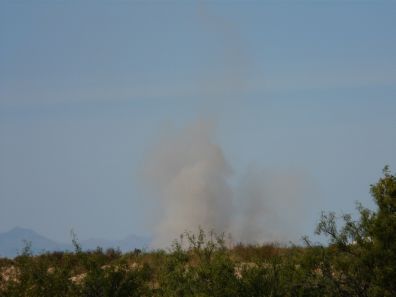
They flew beautifully for the whole flight, but got back above the landing pad early (the flight has to be at least ninety seconds long). They were hovering for what seemed like almost half a minute. The announcer stated that they were hovering close to the ground so that if anything went wrong at the end, it wouldn’t have far to fall.
I’ve no idea what happened, so this is pure speculation. Perhaps they’re not used to flying in the dirt, and didn’t anticipate how much dust would be kicked up. If something in that cloud affected vehicle systems, it will be kind of ironic that in attempting to play it safe, they may have accidentally doomed the attempt at almost the last second.
In any event, John will have something to say shortly. All the money is still on the table. He gets two more tries tomorrow.
[Update a couple minutes later]
Wired (for whom a couple of stringers are sitting across from me) is covering it as well.
[Update at 3:45 MDT]
Clark has more, as does Jeff Foust, Alan Boyle and Leonard David.
[Update a little after four]
Alan Boyle told me that he talked to Neil Milburn, so this is second barstool down, but the prevailing theory seems to be that they had the same problem on the second flight as they did this morning–a restricted fuel line due to contamination. This morning it resulted in a failure to ignite. This afternoon, it resulted in a LOX-rich burn at a higher-than-normal temperature, which apparently cracked the combustion chamber a few seconds before the end of the flight. If so, so much for my “dust theory” above.
They have spare parts, so they can repair overnight and go for it again in the morning. I assume that part of the overnight maintenance will include a complete dismantling and cleansing of the propellant lines…
[Evening update]
You can probably find more details at other places, but my understanding is that they actually had a hard start (that’s a rocket engineering euphemism for “had an explosion in the combustion chamber at ignition”) on the return flight, and they were surprised that it lasted as long as it did, because it was apparently shedding parts through the whole flight. That would explain why they wanted to complete the trip so quickly and then just hover above the pad and hope that they could stay aloft for the full ninety seconds. They came pretty close.
Better luck on the morrow, with a rebuilt vehicle.
Off now to a Space Frontier Foundation reception at the Ramada in Las Cruces.
Armadillo just started back out to the pad for their afternoon attempt. They reportedly had a contaminated line, that they cleaned. Someone was asking me this morning what their chances are, and I (and most others) thought pretty good, given that they’ve already done it, just not here. But things can happen in transport, and things can happen in different venues, and there are no guarantees. The money may still be on the table at the end of the weekend. We’ll soon see, or at least we’ll soon see if they have to wait until tomorrow for one last attempt.
My problems with the Internet are everyone’s. The bandwidth is available in the press HQ, and it’s plentiful. Unfortunately, that building is a ten to fifteen minute walk from the press tent on the flight line, which has no power, and no Internet. It does have a good view, and shade though.
Here are some pictures:
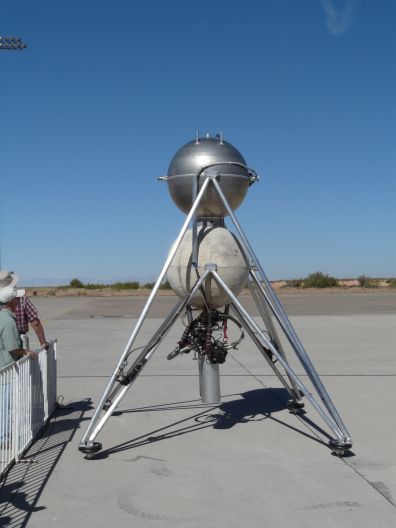
This is the backup to “Mod,” the Level 1 vehicle that was hastily thrown together to replace “Texel, which died in a fire during a test a couple months ago. At the time this was taken, the primary version hadn’t come back from the aborted attempt this morning.
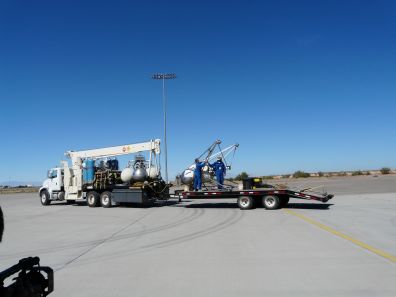
The above is a view of the return of the vehicles after this morning’s scrub. “Pixel” (shown below closeup, and the Level 2 vehicle) is in the front, with “Mod” behind.
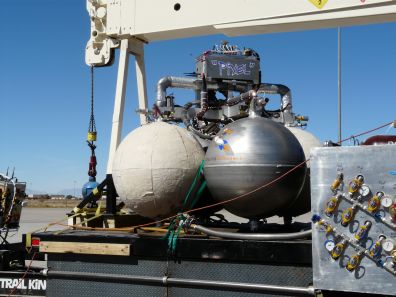
But with problematic Internet connection (no Internet or power in the press tent). But Clark Lindsey is all over it. Just keep scrolling. The key story is that Armadillo made an attempt at Level 1 at 9 AM but scrubbed until this afternoon due to an ignition problem.
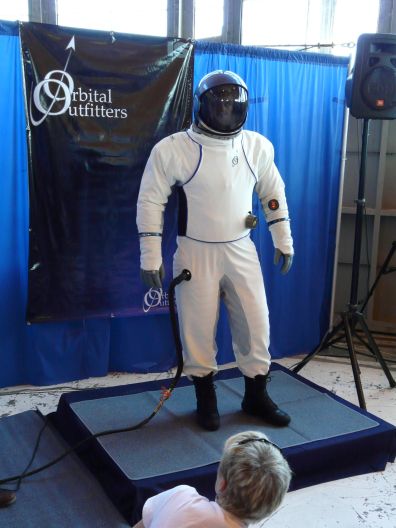
Orbital Outfitters had a press conference at 10 AM at which they premiered their suborbital space suit. It was modeled by its designer, and is aimed initially at the pilot market. A passenger version will be coming along later.
[Update about 1 PM MDT]
In answer to Louise’s questions, it was a working prototype, and the suit was pressurized (not sure to what psi), but there was no comm system. The visor did seem to open pretty easily. I think that there may have been some pockets, but they could be easily added. One of the claimed features is the ability to customize and colorize.
Speaking of the Museum of Space History, as I said, Clark and I visited it. I hadn’t been there since 1993 (when I was out here for one of the DC-X flights) and he had never been.
It’s a beautiful building in a beautiful location, overlooking the valley with the white gypsum sands of the national monument and test range in the distance, with lots of interesting artifacts. But the exhibits seem quite out of date, and are often misleading (particularly the older ones). still Some of it seems frozen in the mid-eighties. If your only source for what was going on in space was this museum, you would think that Russia was flying Buran, and planning a fleet of four or five vehicles. You would think that Ariane IV was the most current version, and that there was no Delta new than Delta II, or Atlas built after the eighties version. Much of the text description is written in present tense, with no way for the reader to know that it is a couple decades out of date. (A more minor issue is that they have the date of the Apollo fire as January 26th, rather than the 27th, and this error has apparently adorned their walls for many years).
I know that it costs money to update and reprint displays, but you would think that with modern computer and printer technology it shouldn’t be that hard. There would be no shortage of visitors, like me (and Clark) who could point out problems to them if there were some easy way to do so. They need an army of editors, and then some good volunteers (who they apparently have already) to implement the fixes.
On the positive side, the newer wing on commercial space, and New Mexico’s role in it, is good (even if there is a little too much NM hucksterism and exaggeration in it). I recommend seeing it, but take some of the displays with a grain (or large bag) of salt, particularly the ones written in present and future tense.