Just to the south of Jefferson, the new state of North California (shown as purple on the map) would be much larger, with a population of almost four million, comparable to Oregon or Oklahoma.
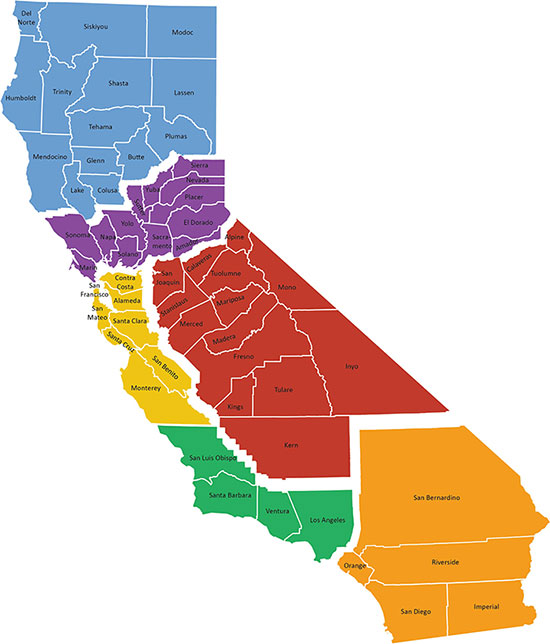
There is no other state that would really be comparable to North California, in terms of geography and climate. Unlike any of the other new states, it would have very little desert. It would have some of the best wine country in the world, in Napa and Sonoma counties. It would have the coastal beauty of Marin as well, just north of the Golden Gate Bridge from San Francisco and the rest of the new state of Silicon Valley to its immediate south. Like Silicon Valley, it will have ocean access via the Golden Gate, from San Pablo and other northern bays, so it would have the option of building its own new ports.
As it is now, western North California would be a bedroom community for the industry of Silicon Valley to the south. With towns like Vallejo, Sausalito, Benicia, Santa Rosa and others along the northern reaches of the San Francisco Bay system and Sacramento Delta, access between the two states would continue to be via ferries and toll bridges to San Francisco and Oakland, and Concord in Contra Costa County. One point of contention in a breakup will be which state gets both responsibility for, and revenue from, which bridges.
The eastern part of the new state would be much more rural, with the northern Sierra Nevada, Lake Tahoe, and Gold Country in the western foothills of the mountains, and its own wine region centered in Amador County. The foothills and mountains will offer recreational opportunities for fishing, hunting, hiking, and horseback, with skiing in the winter in south Tahoe. Gold Country, with its historical towns and sites, will continue to be a tourist draw. While not as high as the Sierras further south, there will be some snow pack in the northern mountains to feed the northern part of the delta, and provide water for the new state.
As with the current California, Sacramento would be a good candidate for state capital. The current Sacramento State would likely become the flagship of North California’s higher educational system, the University of North California. The campus of the University of California in Davis would probably have its focus broadened and strengthened from its current one of agricultural research, perhaps becoming North California State.
It will inherit a number of prisons, in Sacramento, Folsom, Vacaville, Mule Creek in Ione, and of course the infamous San Quentin, just over the Silicon Valley state line from San Francisco. As with Jefferson, it is possible that these will provide excess capacity for its own criminal needs (particularly if it, like Jefferson, were to legalize drugs), given that the majority of prisoners are likely generated by the big cities of Silicon Valley, and West and South California. So there may be opportunities for revenue from those states to continue to house their prisoners. Again, the new state may offer an opportunity for reform with an end to the guards’ unions.
With its current voters, North California will have a twelve-point voting edge for Democrats, 43% to a little over 31% for Republicans and almost 3% for the American Independent Party. But as with Jefferson, about twenty percent of those registered are unpartied, so the right Republican candidate and policies could potentially win the votes of the state for governor, senators and electors. A more libertarian Republican might do well there.
Next up, the city-state of Silicon Valley.
