Category Archives: Political Commentary
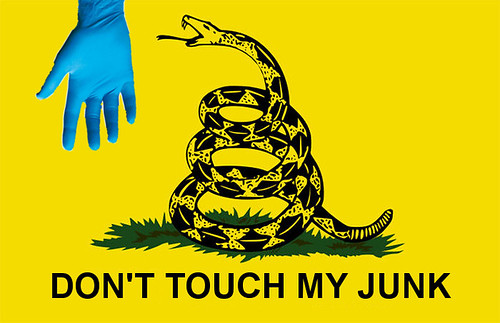
Comply With Me
…Before you fly away.
[Update a while later]
Following the lead of CAIR, as head of the Council of American-Simbergic Relations (CASR), I have just issued myself the following memo:
Special recommendations for Simbergic men who, as part of their quaint and colorful cultural tradition, are required to wear pants in public:
* If you are selected for secondary screening after you go through the metal detector and it does not go off, and “sss” is not written on your boarding pass, ask the TSA officer if the reason you are being selected is because of your trousers, and specifically your skivvies.
* In this situation, you may be asked to submit to a pat-down or to go through a full body scanner. If you are selected for the scanner, you may ask to go through a pat-down instead.
* Before you are patted down, you should remind the TSA officer that they are only supposed to pat down the area in question, in this scenario, the groinal region. They SHOULD NOT subject you to a full-body or partial-body pat-down.
* You may ask to be taken to a private room for the pat-down procedure of said trouser snake, and have it performed by a smokin’ hot woman. You may also ask for extra time, and cigarettes afterwards, if you smoke.
* If there is no woman available, or if she is insufficiently pulchritudinous and compliant with your special pat-down needs, instead of the pat-down, you can always request to pat down yourself, particularly the pelvic area, and have the officers perform a chemical swipe of your hands.
The latter won’t be a major imposition on me, because I already pat down my junkawesome and monstrous instrument of female pleasurin’ several times a day (only in the interests of security, of course), though I usually don’t have anyone to perform the requisite chemical swipe afterwards, so that will be a government-subsidized bonus for me. I am a vaguely semitic appearing person, and I am always very suspicious of me, as are most people who meet me, with good reason. I never know what I may have in my pants.
[Update mid afternoon]
Bailing Out The Academic Vandals
Don’t “save” the humanities — restore them:
There was a time when “save the humanities” would have been an appropriate cry, but that was years ago, when they were being dismantled in one department after another and replaced with the intellectual triviality and sheer boredom of endlessly repetitive Marxist identity politics, as cowardly administrators looked on and did nothing. The poverty of intellectual content was masked by an elaborate jargon, but that only made things worse: the remade programs became the laughing stock of their campuses. But now the day of reckoning has arrived. Enrollments have collapsed, to the point where the smaller departments face extinction. Those enrollments are sinking not because students don’t value the humanities, but because they do.
It is important to grasp the fact that the cry we are now hearing (“save the humanities”) is not about saving the humanities. It is rather about saving the faculty, who long since destroyed them, from the devastating consequences of their own foolish actions. It asks for a bailout, so that those same people can continue enjoying the fiefdoms they created to replace what once were departments of the humanities. And to respond favorably to that appeal would be folly.
Of course, they’ll have to do something for which they’re entirely ill-suited and untrained — making an honest living in the real world.
But Don’t Call Him A Narcissist
I couldn’t help noticing, when we sat down to talk in the dilapidated storefront that houses his Springfield campaign headquarters, that the blue-pen drawing he’d doodled on his newspaper during fundraising calls was a portrait of himself.
Amazing, but even more so is the denial of many of his dwindling supporters about it.
Business Versus Politics
This would explain much:
…after I taped my PJTV interview yesterday with David Kirkham — whose Utah Tea Party toppled Bob Bennett and brought a new Speaker into the Utah State House to boot — and Mike Wilson, whose Cincinnati Tea Party helped paint Ohio red last week, they stayed on the hookup and were talking about how the biggest surprise to both of them, each a political neophyte, was how comparatively easy politics was compared to running a business.
So it attracts mediocrities (if that’s not too kind a word) like Nancy Pelosi and Harry Reid. And Barack Obama. They’re not competent at anything else. Not that they’re particularly competent at that, either.
[Update a couple minutes later]
They’re arrogant people, with much to be modest about.
[Update a while later]
The real Democrat messaging problem: they can’t get people to ignore reality:
This was the progressive agenda in full, with accomplishments and ideas most politicians could only dream of, and yet what happened in this election? The Democrats faced a historic loss with the public turning hugely against them. And why? It really comes down to a messaging problem. Liberals just couldn’t get their voices heard over the noise from their one foe that is always trying to tear down all their plans and belittle every accomplishment: reality.
The reality noise machine — with its job losses, terrorist attacks, and budgets — is always trying to shout down liberals’ ideas with its fear-mongering of actual problems that need to be addressed and a physical reality that needs to be appeased. When liberals create or save millions of jobs with a trillion dollar stimulus, there goes reality saying we’re spending money we don’t have and unemployment is only going up. When a progressive plan is proposed to get everyone free health care, there’s reality with its message of gloom that nothing is free and our health care will only get worse. And if we ever try to appease some nation like Iran through peaceful, diplomatic means, reality is always pointing out how close they are to nuclear weapons. Reality is obnoxious, and these days it’s everywhere, and people are actually listening to it over liberals.
For instance, look at the whole “death panel” debate from a while back. Despite numerous liberal journalists and commentators assuring people that death panels were not mentioned in the health care bill and that it was completely made up, people decided to instead listen to the reality of bureaucracy and limited supply over the intelligent people telling them to ignore that. And when New York Times columnist Paul Krugman constantly argues that we need to spend even more to get out of this economic situation, do people listen to the Nobel Prize-winning economist or reality? These days it’s reality, and people are going to keep choosing reality over their own interests unless liberals learn to fight back with better messaging.
Stupid realists. Who are they going to believe — the “reality-based community” or reality? Come on, people.
The Sequel To “Sarah Palin’s Alaska”
TLC presents Nancy Pelosi’s San Francisco.
Heh.
The Coming Train Wreck
…for commercial space. A warning from Wayne Hale:
NASA at its highest leadership level has committed to try to allow commercial space flight providers a great deal of flexibility and cost control. There are ways to do this which will not compromise safety in design or operation. But having NASA civil servants as the arbiters of whether or not thousands of requirements have been satisfied is not the way to accomplish neither safety nor cost efficiency.
So whether Commercial Space Flight gets $6 billion or $3 billion or $50 million, the entire effort is on the way to a train wreck.
NASA must change or this effort will fail.
No doubt. Part of the point of the new policy was to get NASA to change, but it’s going to be a very painful process, and there will be vicious guerilla warfare in the trenches. The draft requirements are just one of the skirmishes in that war. At some point, they will have to be revealed, to allow them to be properly critiqued before they become something more than draft. If NASA had a strong administrator, he would note that they will be signed off at the top, where the buck stops. But if NASA had a strong administrator, Ed Weiler wouldn’t still be in charge of SMD.
If the train wreck occurs, it will be NASA’s problem, though, not that of the commercial providers. There will be commercial human spaceflight, sooner or later. NASA can make it happen sooner, but they won’t be able to prevent it, and once everyone sees other people flying on SpaceX/ULA/Boeing/Whoever vehicles to Bigelow (and perhaps others’) facilities, it’s going to be impossible for NASA to get the billions some (either at NASA or on the Hill) will request for their own doomed programs, in the coming austere fiscal environment. There is only one way forward for human spaceflight, and that’s commercial providers.
[Update a few minutes later]
I should add that I am not surprised, of course, in any way by Wayne’s report.
Quantitative Easing
…for dummies. But the Democrats still won’t get it.
American Narcissus
The president’s almost dysfunctional vanity has long been on display, but I’ve never seen all the examples put together in one place like this.
Bleeding And Purging
…to balance the humors of the economy:
The Keynesian idea of stimulus has no empirical basis, but the only active tool the government has in a time of economic downturn is its ability to borrow and spend. Surprise, surprise: during the Great Depression, governments fell all over themselves to embrace Keynes’s idea of borrowing and spending to “stimulate” the economy. They did so not because it was proven to work (then or since) but because it justified the one action that would make the government larger and more powerful and the political class larger and more powerful as well.
The Fed is now doing the same thing with inflation “Quantitative Easing”. There is no particular reason to believe that inflating the money supply will produce more real economic activity, indeed the history of the 20th century proves exactly the opposite. However, it is all the Fed can do right now so it is going to grab a convenient theory to justify inflating the currency.
For centuries, doctors tortured and killed their patients because neither they nor their patients had the courage to simply admit that there was little good the doctors could do. They created elaborate and detailed theories to justify their counterproductive interventions. Worse, after a time, everyone, doctors, patients, philosophers, proto-scientists, etc. all came to regard the tool driven rationalizations as facts. Not until the discovery of the germ theory of disease, quantitative chemistry and a general science of diagnostics did the nonsense theory of humors fade away. The invention of new tools drove the development of new, scientific theories.
We are doing the same damn thing with the current economic travails. Rather than admit there is little that the government can do to correct its colossal real-estate screwup, we get to witness the economic equivalent of bleeding and induced vomiting all based on a economic theories that have no other reason for existing that to justify the government bleeding and inducing vomiting in the economy.
“… but it’s what can be done,” could well be one of the most dangerous phrases in the English language. In very many cases, not just economics, the best thing to do is nothing. For any particular bad circumstance, there are near infinite number of actions that can make the circumstance worse but only a very few that can make it better. Indeed, there is no natural law that says that every circumstance can be improved with the capabilities at hand. Sometimes a “can do spirit” backfires. Some circumstances are like earthquakes or tornadoes: you can’t stop them, you just have to ride them out.
Don’t just do something; stand there.