Some people have noted to me that I’m not as vociferous in conference sessions as I used to be. This is sort of the template I use now.
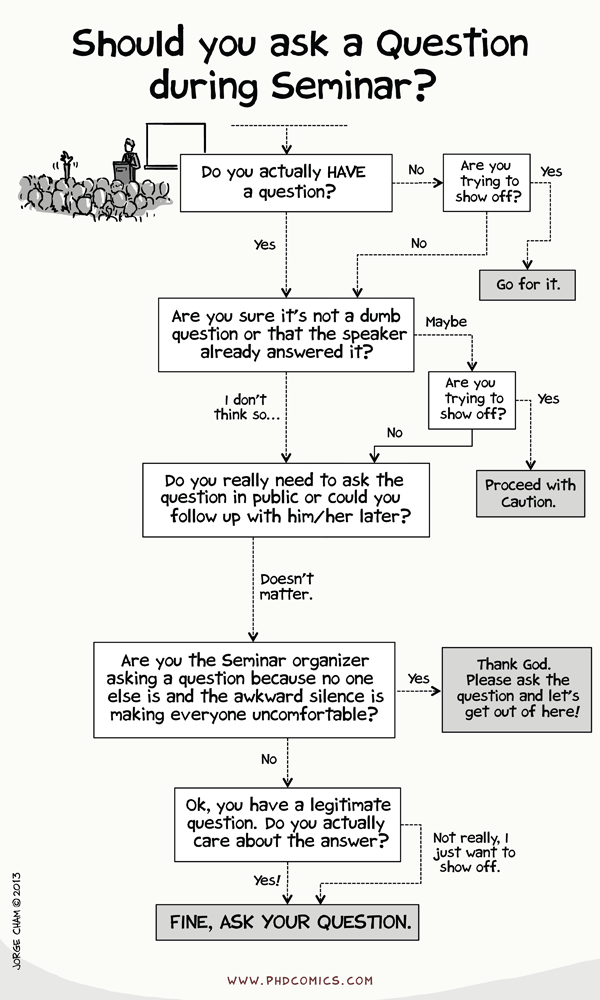
It would have served me well in my younger, more impetuous days.
Some people have noted to me that I’m not as vociferous in conference sessions as I used to be. This is sort of the template I use now.
It would have served me well in my younger, more impetuous days.
…and its inconvenient truth:
Based upon early drafts of the AR5, the IPCC seemed prepared to dismiss the pause in warming as irrelevant ‘noise’ associated with natural variability. Under pressure, the IPCC now acknowledges the pause and admits that climate models failed to predict it. The IPCC has failed to convincingly explain the pause in terms of external radiative forcing from greenhouse gases, aerosols, solar or volcanic forcing; this leaves natural internal variability as the predominant candidate to explain the pause. If the IPCC attributes to the pause to natural internal variability, then this begs the question as to what extent the warming between 1975 and 2000 can also be explained by natural internal variability. Not to mention raising questions about the confidence that we should place in the IPCC’s projections of future climate change.
Nevertheless, the IPCC appears to be set to conclude that warming in the near future will resume in accord with climate model predictions.
Why is my own reasoning about the implications of the pause, in terms of attribution of the late 20th century warming and implications for future warming, so different from the conclusions drawn by the IPCC? The disagreement arises from different assessments of the value and importance of particular classes of evidence as well as disagreement about the appropriate logical framework for linking and assessing the evidence – my reasoning is weighted heavily in favor of observational evidence and understanding of natural internal variability of the climate system, whereas the IPCC’s reasoning is weighted heavily in favor of climate model simulations and external forcing of climate change.
The models are utterly useless, as a basis for public policy. In fact, to the degree that people don’t understand this, they’re worse than useless.
[Update a few minutes later]
Related: no ice-free Arctic this year. Mazlowski is falsified.
Some apparently politically incorrect thoughts from Sarah Hoyt.
Judith Curry reviews Donna Laframboise’s new book
The 2007 IPCC report mistakenly said that Himalayan glaciers were in danger of disappearing by 2035. When various parties tried to tell the IPCC this was ludicrous, Pachauri called those people names and disparaged their intelligence. He said they were practicing “voodoo science” and “schoolboy science.” Eventually, however, the IPCC admitted its glacier claim was wrong.
…Pachauri has publicly ‘joked’ that his critics (aka climate skeptics) should be given a one-way ticket to outer space. He has alleged that they are part of a “carefully orchestrated” campaign, and that they believe “asbestos is as good as talcum powder – and I hope they put it on their faces every day.” Are these remarks worthy of the leader of a prominent international body?
No. He’s a hack. And so is John Kerry for praising him.
…exists primarily in mythology:
There is deeply ingrained in American culture — particularly nowadays on the Left — the stereotype of the scientist as pure in intent and action, caring only for the Truth, let the chips fall where they may. The scientist works readily with other scientists (except when s/he is working alone, late into the night, thinking deep thoughts), accepts — nay, encourages — challenges to her/his theories and findings, welcomes new information and hypotheses, and is always willing to change his/her mind based on better data, models, and/or reasoning.
It is, to quote the late Douglas Adams, a load of dingos’ kidneys. A very large, steaming, rotting load of dingos’ kidneys.
Particularly when it comes to a politicized field like climate “science.”
The World Federation of Scientists says it’s not a planetary emergency. So #ScienceSaysSo, right? #Consensus.
I’ve posted about this before, but here’s another article on the concept. I often wake up in the middle of the night, but we have to get up early in the morning, regardless of how much we sleep. Unfortunately, it’s not practical for people who work modern industrial jobs.
A paleo blog I hadn’t noticed before, though it seems to have been around for several years (at least in one form or another).
Scholars and Rogues imagine that they have a useful critique of our latest filings in the MannSuit, but they completely misunderstand the situation:
These examples demonstrate that both NR and Steyn were aware of ongoing investigations, and that NR was certainly aware of the results of at least one of those investigations. Furthermore, it is not realistic to imagine that NR cultivated a culture where authors writing about the same subject (climate change/global warming) were so isolated from each other that they never discussed the results of the various investigations among themselves. As such, it is virtually certain that NR and Steyn were aware of the investigations’ results and thus cannot credibly claim ignorance of those same results. [Emphasis in original]
This, with all respect, is stupid. Or it’s smart, but a complete straw man. None of the defendants have claimed that they were unaware of the results of the investigations. In fact, the original blog post that I wrote was all about the results of those investigations, and why we and others disagreed with them. They (and Mann) are attempting to claim that the investigations a) properly investigated all accusations of malfeasance against him and b) exonerated him of all such claims. Both are (in our opinions) untrue. The investigations, to the degree that they happened, were limited in their scope, and for the most part cursory (e.g., the Penn State “investigation” basically consisted of asking Mann if he did anything wrong, without questioning anyone else, and when he replied in the negative, “exonerated” him). That is what the entire dispute is about, so it’s obtuse and pointless to claim that we claim that we were unaware of the investigation results.