I’m at a workshop on how to look for it at UC Irvine, so posting will be light today.
Category Archives: Space
The Future Of Space
As we mourn the loss of a pioneer, it’s important to note that it lies with the billionaires, not NASA or other government programs:
“One [path] is that we stay on Earth forever and then there will be an inevitable extinction event,” [Bezos] told the audience of scientists and engineers. “The alternative is to become a spacefaring civilization, and a multi-planetary species.”
Ashlee Vance, longtime tech journalist and author of Elon Musk: Tesla, Space, and the Quest for a Fantastic Future, thinks these ambitions are driven by a mix of entrepreneurial curiosity, altruism and a dash of egotism. “The guys who are rulers of the universe now are the nerds,” he says. “They were all geeks raised on science fiction and the vision of space we had in the 1960s and 70s. Now they have the money to make this a reality.”
Yes.
Loretta Jackson Delong (1948-2016)
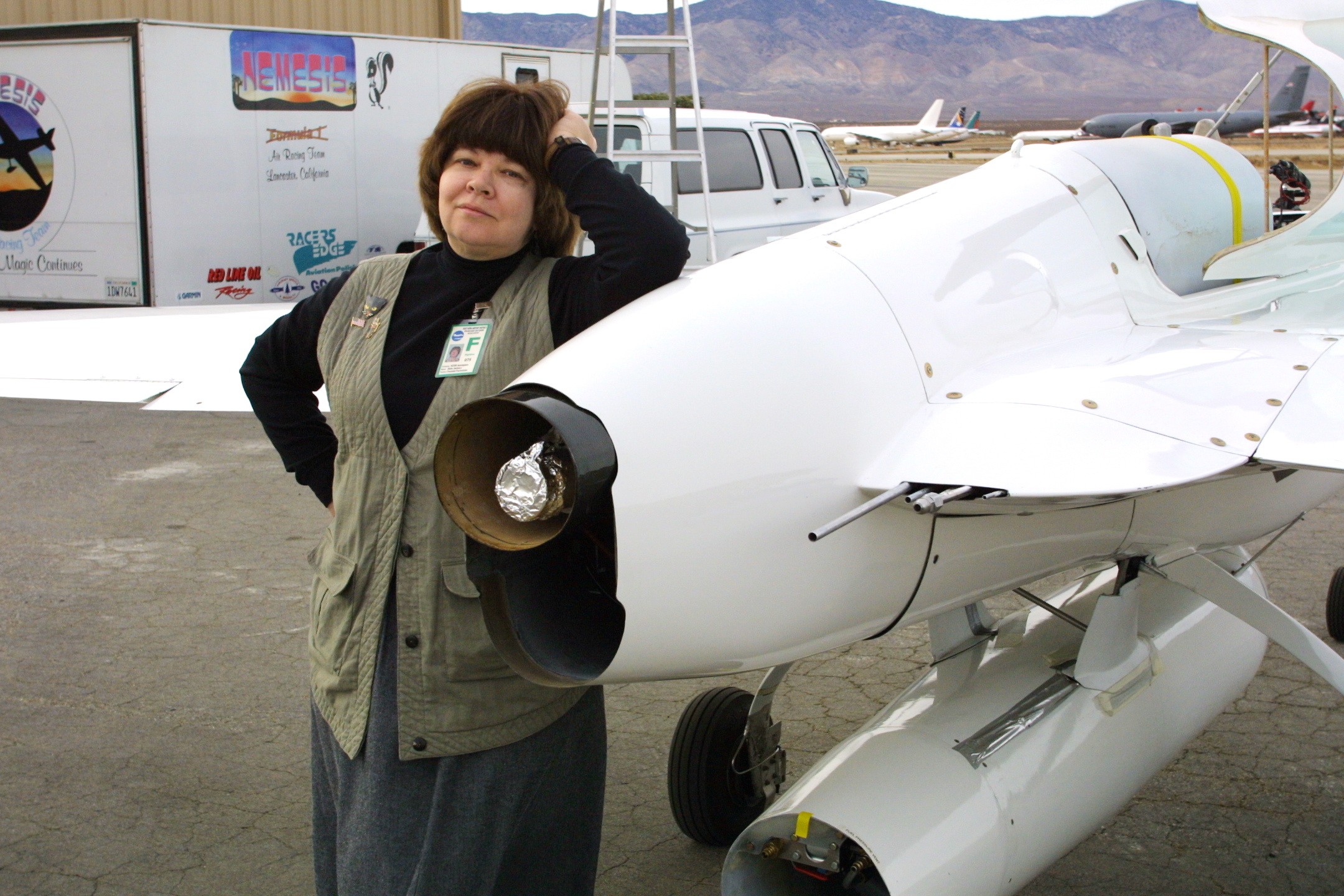
Received this morning:
Aleta, as she was known to all, passed away this morning in the Midland hospital ER. Aleta knew from the time she was twelve that she would build and fly spaceships. Her first professional work was as an engineering co op from Indiana Tech working on the Gemini program for McDonnell. Her engineering degree was cut short when she went home to nurse her mother back to health. After that, she joined the USAF as airman Jackson.
Aleta worked for Xerox for ten years as a repair technician and wrote both science fiction and non-fiction stories. She worked for the L-5 Society, both in Tucson and later in Washington DC. During her stay in DC, Aleta became an aide to General Daniel Graham and helped create the DC-X launch vehicle, later renamed the Clipper Graham. She also edited the Journal of Practical Applications of Space while with Graham’s Strategic Defense Initiative Organization.
As an indefatigable supporter of launch vehicle development, Aleta then became one of Rotary Rocket Company’s first employees, where she was general office manager. When the propulsion group was laid off from Rotary, Aleta was the person who told Jeff Greason, Dan DeLong, and Doug Jones that they had to stick with it, and founded XCOR Aerospace.
In the beginning, because the XCOR founders received no pay, Aleta took an additional job as a reporter/editor of the Mojave Desert News. Meanwhile, she was XCOR’s purchasing, personnel, bookkeeping, editorial, receiving, community outreach, and travel departments. As the company grew, she shed most of these tasks. In late 2015 she helped Jeff Greason start Agile Aero. Aleta was a personal as well as professional partner of Dan DeLong since the early days of Rotary, and they were officially married in 2016. The very next day, however, she was diagnosed with ovarian cancer, and succumbed to complications of the chemotherapy regimen.
My deepest condolences to Dan, and her friends and family. She was a long-time friend and occasional colleague, and no one I know fought harder for our future in space.
[Monday-morning update]
I’ve added what Dan tells me was one of her favorite pictures of herself.
[Monday-afternoon update]
I encourage people to read all of the kind and understandably heartbroken comments, but this one from Dan is important for those who knew her:
Thanks all for the kind words. In order to allow time for those traveling, and to get around the holidays, the memorial service will be Sunday, Jan 15 at the Christian Church of Midland at 2608 Neely Ave. Thanks again, Dan.
I don’t know if I’ll be able to make it, but I’ll try.
[Monday-evening update]
Henry Vanderbilt remembers Aleta’s akita, Rufo.

I do as well, because thanks to Rufo’s and Henry’s generosity, I once shared a hotel room with them at the Space Access Conference (despite my allergy to dogs, but I survived, and he was a great dog. And I’ve done that more than once, even after the passing of Rufo, despite the fact that I snore, for which I’m grateful to Henry, and will always regret any loss of sleep on his part).
[Late-evening update]
Via Clark Lindey, here is the local news reporting:
Greason, who is now the founder of upstart Midland-headquartered Agile Aero, said DeLong’s role in XCOR was invaluable in helping ideas become reality but that she always stayed in the background.
“During the time before I came to know her in the late ’80s and early ’90s, the idea of commercial or reusable space vehicles was a lonely idea to be a champion of,” he said. “She was one of a very small number of people running around and keeping that idea alive. She was never somebody who put her name on the front door, but wherever you turned … you’d find her as the person keeping the community together.”
Yes. I feel like Aleta was always there, and there is a big hole in my life that she no longer is.
[Update late evening]
Here’s a guestbook via legacy.com (not sure how official this is, but it’s via NASAWatch, and Keith apparently cannot bring himself to link to this website, despite the numerous encomia here, and its current numero-uno ranking on Google for Aleta’s name).
Sarah Hoyt
Tardigrades
They’ve figured out how they avoid radiation damage, and humans may be able to do it, too.
Mark Whittington
His latest nonsense:
The problem, from the perspective of commercial space supporters, is that Shank represents an institutional, NASA-centric viewpoint where it comes to space exploration. While at the space agency he supported the Bush-era Constellation program which was subsequently canceled by President Obama. In Congress, Shank helped support the Orion spacecraft and the heavy lift Space Launch System. Many commercial space advocates find these views abhorrent, believing that NASA should simply outsource its space exploration plans to the private sector, to companies like SpaceX and Blue Origin.
I don’t know any commercial space advocates who believe that. What we believe is that there is no need for NASA to be in the launch business.
Shank’s association with Mike Griffin has also raised some hackles. Griffin has been blamed, unfairly for the most part, for the troubles that beset Constellation before it was cancelled. In fact many of these problems, including the fact that the project was underfunded, occurred above his paygrade.
There is nothing unfair about blaming Mike Griffin for choosing a terrible rocket design that was certain to cost more than was allocated for it in the budget sandpile, in the belief that he could somehow talk Congress into increasing his budget.
Russia’s Rockets
“The Russian space sector is short of funding, and may be having difficulties maintaining its quality control standards,” said John Logsdon, a Planetary Society board member and professor emeritus of political science and international affairs at George Washington University.
Additionally, Russia’s workforce is shrinking. Since the 1990s, the country’s population has steadily declined, despite an influx of more than 9 million immigrants. Those migrants have filled some of the country’s job vacancies, but the overall effect, according to the Brookings Institute, is that Russia faces a sharp decline in labor quality.
Worse yet, due to larger economic pressures, the country isn’t able to make large-scale education investments, said David Belcher, an analysis manager at the Washington, D.C.-based Avascent consulting group.
“The effect of that is that they have a skills mismatch in certain industrial sectors, that appears to include the launch industry,” he told me. “The fact that we’ve seen several instances of Russian rockets not working as designed the past few years seems to support that thesis.”
And yet we’re relying on them to get our astronauts to the ISS, because “safety is the highest priority.”
[Mid-afternoon update]
Looks like the stage went kablooey. Which is kind of bad, because it’s the same one they use for crew. Wonder if it would have been abortable?
[Update a few minutes later]
A reminder that Jim Oberg warned about this over a year ago.
Life In The Solar System
The top eight places to look for it. Not including earth, of course.
I think that Carolyn Porco thinks that Enceladus is a better candidate than Europa, but it’s a lot harder to get to.
Trump Space Policy
Lee Billings has a good piece on the current state of play.
Fortunately, given the vision being displayed by wealthy entrepreneurs like Jeff Bezos, we are approaching a day in which NASA and its budget will be largely irrelevant to humanity’s move into space.
Nuclear Batteries
OK, so how soon could this be available for a planetary mission? What’s the power/mass ratio, and cost, compared to an RTG?