I’ve been on a telecon all day on the NASA Advisory Council meeting at JPL. Some very interesting discussion on launch and technology issues. I’m generally impressed with the tech plans, except for the absence of serious ISRU.
Category Archives: Space
Politicos Put Graft Before Progress
While this is a good general topic, nowhere is it more true than in human spaceflight:
Sometimes the new competition wins anyway. Uber has been good at generating a large base of mobile customers, then using them to pressure politicians: When New York City Mayor Bill de Blasio went after Uber, Uber used its app to let its users pressure de Blasio.
Happy Uber customer Kate Upton weighed in, producing more pushback than de Blasio could withstand — especially when it turned out he’d gotten over $550,000 in donations from taxicab interests.
Other services aren’t so lucky, and the ability to do an end run around regulators, though welcome, isn’t universal. And if, on top of setting up your lemonade stand, you need licenses, permits, lobbyists and subsidies to make it, not many new lemonade stands will get started. That’s good news for existing lemonade stands, and for the politicians they support, but it’s bad news for everyone else.
Including people who actually want to affordably accomplish things in space.
Good Space Policy Advice
Stephen Smith has some for the presidential candidates:
U.S. Census statistics show that more people alive now were born after Apollo (185 million) than before (123 million). For the majority of the population, the 1960s Space Age is a page in a history book, and has little personal emotional resonance.
So do yourself and the nation a favor. Don’t invoke Kennedy.
As your campaign staff develops its space policy white paper, begin with a fundamental question — why should people be in space?
Yes.
Busy Moon Day
First (as he told me last week he planned to do), Charles Miller rolled out his proposal for a return to the moon, using commercial launchers, at the National Press Club. I haven’t read it yet, but I’m sure it will contain a lot of good info to inform my own project.
Second, Elon had a press telecon to present preliminary findings on the accident. It was apparently a broken strut on the helium tank in the LOX tank, which failed at 20% of the rated strength (it seems to have failed in tension). Return to flight no sooner than September, depending on customer willingness to fly, redesign of strut (and new supplier). Falcon Heavy first flight delayed until Q2 next year. He admitted that it may have occurred due to “complacency” after long string of successful flights. Most current employees had never seen a failure.
[Update a few minutes later]
Alan Boyle (who seems to have retired from NBC, congratulations) has the story at Geekwire.
[Tuesday-morning update]
Here’s a description of what went wrong from the Space Access Society.
[Update a few minutes later]
Here’s Stephen Clark’s takehttp://spaceflightnow.com/2015/07/20/support-strut-probable-cause-of-falcon-9-failure/ over at SpaceflightNow.
Evoloterra
Today is the 46th anniversary of the first human visit to the surface of our moon. There is a ceremony that can be downloaded to commemorate it here, and two of the authors (I and Bill Simon) will be discussing it on The Space Show this afternoon at 5-6:30 Eastern, 2-3:30 Pacific.
SLS
Almost every sentence of this Cooke, Cook and King SLS op-ed is high-octane unadulterated unsubstantiated bullshit. http://t.co/TRtZCEoffj
— Rand Simberg (@Rand_Simberg) July 15, 2015
I'm going to put up a blog post about this despicable SLS op-ed before I drive up to New Space. Set phasers to fisk. http://t.co/TRtZCEoffj
— Rand Simberg (@Rand_Simberg) July 15, 2015
Let the fisking commence: Continue reading SLS
On The Road Again
Heading up to San Jose. I’ll be checking in later, though via laptop.
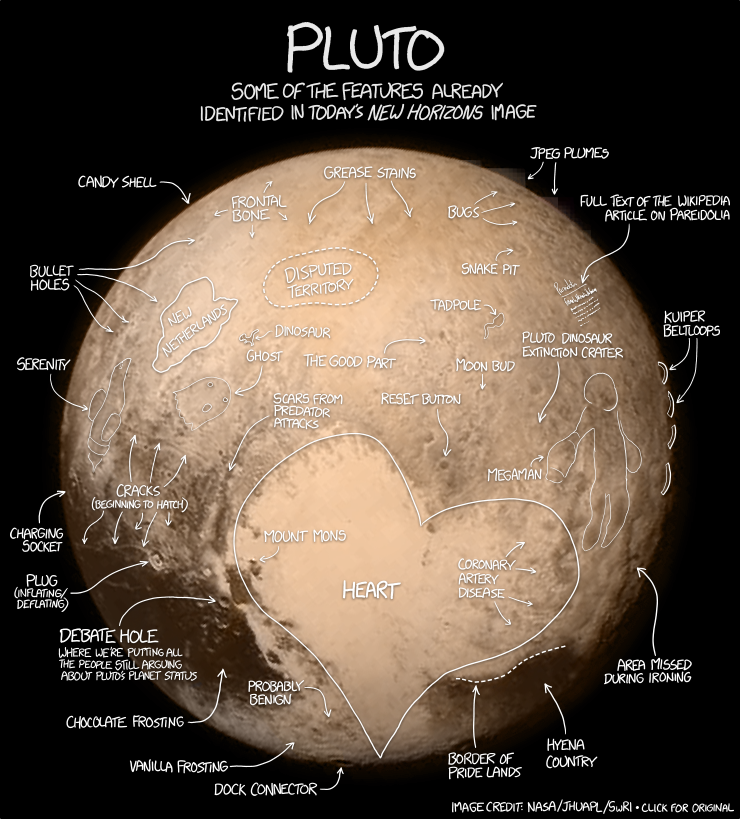
The Last Unknown Planet
SpaceX’s Path To Reliability
Doug Messier has a long but useful piece on the current state of affairs.
We’ve been trapped in a moribund, high-cost space-transportation industry for decades because the cost of each flight is so high that it doesn’t allow for anything resembling real flight test. That has traditionally meant that much verification of design is by analysis, rather than test, and design changes are careful and rare. Working on more of a software model with frequent upgrades, SpaceX has broken that mold, with probably every vehicle slightly different, continuously improving the system, but walking a fine line with risk of failure from something new and untested. But a software change rarely has unrecoverable catastrophic consequences, as a rocket launch can. I suspect that ultimately the finding will be that such a change had an unanticipated effect that caused the recent loss.
ULA can’t (or at least traditionally hasn’t been able to follow) the same philosophy because of the conservatism of its customer, which values reliability above all else for its expensive, critical payloads. This makes it difficult to quickly evolve its own designs (one of the reasons, no doubt, that Tory Bruno wants a new rocket, rather than a re-engined Atlas that he knows won’t be competitive with SpaceX). One of the challenges they will have is how to break out of that mode.
All But Dissertation
…and happy with it:
Grad school became a financial burden after I took my full-time job in industry. Although my salary tripled and I’m a frugal and financially responsible person, my school expenses became too much for me to handle without taking on student loans, something I hadn’t done since undergrad. I managed to avoid student loans by depleting my savings.
After I left my university department’s employment as a graduate research assistant, I was responsible for my tuition payments. I was only enrolled in 3 credits per semester for a doctoral research course, basically, a symbolic class for the privilege of calling myself a doctoral student. Unfortunately, once I left my department’s protection, the university saw me as a dollar sign instead of a person. They used a loophole to unfairly charge me over triple the tuition rate, and even my protest to the university president landed on deaf ears because universities are all about profit (and I attended a public university!).
Had I been charged a fair tuition rate, I would have been able to afford to stay enrolled in grad school indefinitely and may have eventually finished. The greed of the university forced me to make my decision to quit when I did, which may have been a good thing in the long run because I didn’t drag it out too long. To this day, I regret paying that last semester’s tuition, as that money would have served me much better in my savings account.
The current higher-educational system, fueled by the student-loan system, has become, with exceptions, a massive scam.