We’re driving over to Phoenix late this afternoon, but the conference has started, and Clark Lindsey is posting notes, here and here.
Category Archives: Space
An Authentic Screed
That is to say, a righteous screed about suburbia and authenticity,and our intellectual betters (just ask them!) in the “studies” departments, by Lileks, unleashed by the not-to-be-lamented death of Paolo Solari.
You know, it strikes me that these snotty urbaphiles should love the idea of space colonies, at least in the regard of their being planned communities.
National Space Symposium
Boy, they just don’t seem to be able to catch a break. First, the sequester is preventing some big-name speakers from attending (and probably attendees as well), and now there’s four to eight inches of snow forecast for Tuesday. Guess I’d better pack some winter gear for my trip tomorrow.
Humans To Mars
A conference, in early May. What I find interesting is who is not on the schedule. Check out the “Z”s.
I may try to raise money for a publicity event there for my book.
Fusion Propulsion
Are we on the verge of a breakthrough? Let’s hope so, but I’ll believe it when I see it. It’s a game changer if it happens.
Redefining America (And Space Policy)
Larry Greenfield writes that those who prefer tyranny are winning. Unfortunately, like many conservatives, he doesn’t understand what’s going on with space policy:
American innovation both promoted and benefited from the space race. Today, Mr. Obama has lowered his sights, cut NASA spending, and opposed lunar exploration and continued human spaceflight.
This is simply untrue. The administration hasn’t cut NASA spending — the Congress has, on a bi-partisan basis. And while the administration did shut down the disastrous Constellation program whose stated purpose was to get us back to the moon, it had no real prospects of doing so. They have not “opposed continued human spaceflight.” They have repeatedly requested funding increases for commercial crew, the only NASA program with any chance of getting Americans to orbit on American rockets in this decade, and Congress has repeatedly cut the funding for it. One can argue about how effective the administration’s plans will be, but to say that they oppose human spaceflight is simply false as a matter of objective fact. In fact, in its actions of wasting billions on an underfunded, unneeded new rocket, and starving of funds the programs actually needed to get humans beyond earth orbit, one could say that it is Congress, including many of the Republicans within it, that is objectively opposing continued human spaceflight.
B612
Instapundit interviews Ed Lu about asteroid hunting.
Life Support
Here’s an interesting schematic that describes how they plan to keep crew alive to Mars and back. Doesn’t look like they’re trying to recover water from feces, but that makes sense if they’re going to use them for radiation protection. And they’re venting methane. I’d think that it would be interesting to consider it as fuel for RCS, but perhaps that’s too high a technology risk for a mission that has to leave in less than five years. I don’t see any power input to the system, but I guess that’s a separate issue.
Here’s the full briefing to FISO.
[Via NewSpace Watch]
[Update a few minutes later]
OK, looking over the briefing, the current baseline seems to be two launches, one for propellant and one for crew, within a couple weeks of each other.
SLS Delenda Est
Kill it to save human spaceflight:
Simply put, the SLS program should be canceled now to free up approximately $10 billion programmed for this decade. This money could then be redirected to continue the planned flight tests of the Orion spacecraft with the much lower-cost Falcon Heavy booster while making a robust investment in a first-generation space station in the vicinity of the Moon. An investment in such a cislunar station would provide—by the early 2020s—a multifunctional platform to act as a fuel depot, a workstation for robotic operations on the Moon and a habitat to protect against the more intense radiation environment outside of the Earth’s magnetic field. This station could even be used as a habitat during longer-duration human missions to an asteroid and eventually to Mars.
Expect to see a lot more editorials like this as time goes on, new systems appear, and budgets get tighter.
KSC Fire
I just got an email that NASA personnel are being evacuated from a brush fire south of the VAB on Merritt Island.
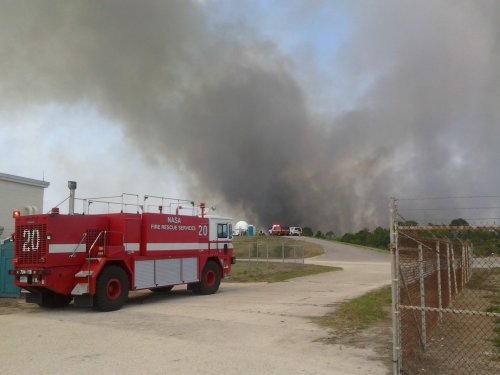
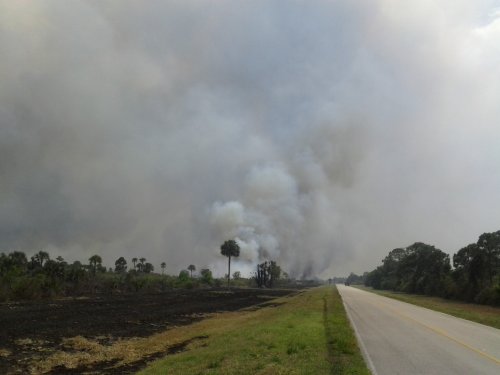
“Tel-4 road runs north/south for two miles then turns west for two miles until it hits the river. So if the fire jumps that E-W stretch of highway it is off KSC property and into civilian land. There’s a pretty respectable north wind today, so it’s a bit dicey until they get that back-burn done.
The second image is looking due south. So the VAB is to my back (to the north) about 6 miles. In that image, the land to the left is KSC property, the land on the right (about where the truck is down the road) is privately held.”