I haven’t written anything about the former Canadian defense minister’s recent descent into (literally) loonytunes madness, but Thomas James has a good roundup.
Category Archives: Space
More Space Plans From “China”
Via Mark Whittington, an article in which he (as usual) takes false hope, with a misleading title: “China Aims to Put Man on Moon by 2020.”
But if you read the article, it’s clear that “China” has no such “aims.” The only person with such “aims” is the “deputy commander of the Chinese manned spaceflight program.” He himself makes clear in the paragraph following that this is not (yet) a national goal:
But the goal is subject to getting enough funds from the government, Hu said, explaining that the space program must fit in the larger scheme of the country’s overall development.
If Mike Griffin’s deputy said, “I think that in about fifteen years, we could have the capability to send humans to Jupiter,” would Mark then agree with the headline “US Aims To Put Man On Jupiter By 2020”? Would he say that there are “indications” that this is a US goal?
Well, given his apparent gullibility, perhaps he would.
[Monday morning update]
Mark amusingly (as usual) misses the point:
Of course landing a man on Jupiter and landing one on the Moon are exactly analogous. At least it seems Rand thinks so.
First of all, I didn’t say “land a man on Jupiter.” But then, reading comprehension has never been Mark’s strong suit, either, at least when it comes to reading me. But ignoring that (non-trivial) distinction, for the purpose of this discussion, they are in fact analogous. The point is that a statement of technological capability (and we could in fact send a man to Jupiter if we so chose in that time period, not that it would be a sensible thing to do) is not a statement of intent, or a declaration of a national goal. Even Mark might realize this, if he actually read the article he cites with such misplaced hope, and thinks about it a little.
More Space Plans From “China”
Via Mark Whittington, an article in which he (as usual) takes false hope, with a misleading title: “China Aims to Put Man on Moon by 2020.”
But if you read the article, it’s clear that “China” has no such “aims.” The only person with such “aims” is the “deputy commander of the Chinese manned spaceflight program.” He himself makes clear in the paragraph following that this is not (yet) a national goal:
But the goal is subject to getting enough funds from the government, Hu said, explaining that the space program must fit in the larger scheme of the country’s overall development.
If Mike Griffin’s deputy said, “I think that in about fifteen years, we could have the capability to send humans to Jupiter,” would Mark then agree with the headline “US Aims To Put Man On Jupiter By 2020”? Would he say that there are “indications” that this is a US goal?
Well, given his apparent gullibility, perhaps he would.
[Monday morning update]
Mark amusingly (as usual) misses the point:
Of course landing a man on Jupiter and landing one on the Moon are exactly analogous. At least it seems Rand thinks so.
First of all, I didn’t say “land a man on Jupiter.” But then, reading comprehension has never been Mark’s strong suit, either, at least when it comes to reading me. But ignoring that (non-trivial) distinction, for the purpose of this discussion, they are in fact analogous. The point is that a statement of technological capability (and we could in fact send a man to Jupiter if we so chose in that time period, not that it would be a sensible thing to do) is not a statement of intent, or a declaration of a national goal. Even Mark might realize this, if he actually read the article he cites with such misplaced hope, and thinks about it a little.
More Space Plans From “China”
Via Mark Whittington, an article in which he (as usual) takes false hope, with a misleading title: “China Aims to Put Man on Moon by 2020.”
But if you read the article, it’s clear that “China” has no such “aims.” The only person with such “aims” is the “deputy commander of the Chinese manned spaceflight program.” He himself makes clear in the paragraph following that this is not (yet) a national goal:
But the goal is subject to getting enough funds from the government, Hu said, explaining that the space program must fit in the larger scheme of the country’s overall development.
If Mike Griffin’s deputy said, “I think that in about fifteen years, we could have the capability to send humans to Jupiter,” would Mark then agree with the headline “US Aims To Put Man On Jupiter By 2020”? Would he say that there are “indications” that this is a US goal?
Well, given his apparent gullibility, perhaps he would.
[Monday morning update]
Mark amusingly (as usual) misses the point:
Of course landing a man on Jupiter and landing one on the Moon are exactly analogous. At least it seems Rand thinks so.
First of all, I didn’t say “land a man on Jupiter.” But then, reading comprehension has never been Mark’s strong suit, either, at least when it comes to reading me. But ignoring that (non-trivial) distinction, for the purpose of this discussion, they are in fact analogous. The point is that a statement of technological capability (and we could in fact send a man to Jupiter if we so chose in that time period, not that it would be a sensible thing to do) is not a statement of intent, or a declaration of a national goal. Even Mark might realize this, if he actually read the article he cites with such misplaced hope, and thinks about it a little.
SpaceX Launch
Out of the Cradle is live blogging it. They seem to be weather delayed right now.
[Update at about 3 PM Pacific (two hours before the launch window closes]
They need to check valves on the LOX fill tanks and then clear the area restarting the countdown in 1 and a half to two hours.
What been driving the delays? weather? equip?
Weather at one point – then lox – no other
Boiloff of mechanical – doesn
One More Delay
Today’s Falcon 1 launch has been delayed until tomorrow:
In order to facilitate preparations for a missile defense launch, the Army Space and Missile Defense Command (SMDC) has bumped the SpaceX Falcon 1 maiden flight from its officially scheduled launch date of 1 p.m. California time (9 p.m. GMT) on November 25. The new launch time is 1 p.m. California time (9 p.m. GMT) on November 26.
More On SpaceX
Here’s Tariq Malik’s story
First Launch
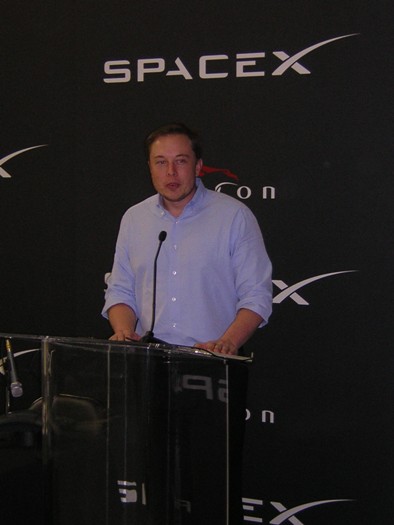
I took a lot of notes at the SpaceX press conference in El Segundo today, but I think that the proceedings will be available at their web site, so I’ll just put down some highlights and thoughts. While I was there, I’m probably less valuable as a reporter than as a participant, because I asked several questions. Fortunately (for me, though not necessarily for the company from a PR standpoint), as I noted earlier, the attendance by the media was sparse, so I was front and center, with an opportunity to almost interview Elon in real time. I should note that he didn’t say a lot that was new here, but it was a good opportunity to hear it all in one place at one time. This may ramble a little, because I’m one of those guys in their pajamas who don’t have editors…
He was clearly confident and happy with the current situation. When asked if he was nervous, he responded that he was actually relieved, because he feels that they’ve now done everything possible (or at least reasonable) to ensure success of this critical first launch, and are “at peace with themselves.”
I think that what came through most to me was that there is clearly a vision to this venture, and that while he’s happy for the business from DARPA and the Air Force, the ultimate purpose is not to deliver military satellites cheaper.
He is clearly doing this because he believes that it is important, even imperative, that we help life expand out into the universe (he even explicitly said that–unlike many, he didn’t do this to get himself into space–he did it so others could). That’s not a usual motivation (at least voiced) for an entrepreneur, and it could cause some stockholders to be concerned that it will take primacy over returns, but this is mitigated by the fact that he is clearly a successful businessman with a track record.
Along those lines, when asked about his lawsuit against Boeing and Lockmart, he noted that many times, if there were victories in such things, they were often posthumus. He said that he wanted his legal victory to be “prehumus.”
He gave some hint of what he has in mind for a tourist market, mentioning that a Falcon 9 could deliver a “loop around the moon.” One more bit of evidence (besides the launch contract) that he’s been talking to Bob Bigelow.
Some interesting (to me) tidbits:
- This will be the first orbital launch from Kwajalein
- The Merlin II engine will be the largest (by thrust) in the world (though not in history–it won’t beat the F1)
- First stage is most mass efficient in the world
- Second stage is most mass efficient in the world for a pressure-fed engine
- He’s planning to raise funds early next year to complete Falcon 9 (he thinks he needs another hundred million) but will fund it himself if this is unsuccessful
- He’ll be designing the Falcon 9 to 40% structural margin (airframe, meaning passengers) rather than the traditional unmanned spacecraft margin of 25%, and make it triple redundant (rather than the single-string Falcon 1)
- He agrees that “human rating” may be a chimera, and agrees that it’s senseless to design a vehicle to less reliability for hundred-million-dollar satellites than for people
- He’s encouraged by recent legislation, and will lobby for ITAR relief (specifically mentioning the ridiculous situation that we treat Canada and New Zealand exactly like North Korea), but it isn’t the company’s highest priority
- He’s had dinners with Jeff Bezos, and he shares the vision for expanding humanity into space, and they may collaborate at some point, but there are no specific plans
- Paul Allen may be visiting the plant soon, but has expressed no explicit interest in investing
He did say one thing that concerned me. When asked if he had considered a dummy upper stage on a first-stage test, he pointed out that Apollo had tested all up. I’m not sure that Apollo was the best model to follow, given that they had unlimited funds, and were in a race. Also, he said that he thought a successful launch would validate their design, but he’s mistaken about that. It might merely validate their luck. You can’t go and focus on manufacturing quality from a single successful launch–it will take many launches to develop a level of confidence in both design and manufacturing. I hope that they will rethink this philosophy.
Overall, though, I was encouraged, and will be cheering for them next Friday.
[Update late evening]
Michael Belfiore was live blogging it. Clark Lindsey also has good notes.
Why Air Force Space Programs Are Mismanaged
Kevin Parkin has an interesting post on post-graduate education for blue brass. This is a problem not just for procurement and program management in general, but for strategic military vision for space.
SpaceX PRess Conference
I played hooky today for an hour or so and attended the press conference that Elon Musk held over at SpaceX. Bottom line, a launch next Friday at 1 PM Pacific (Saturday morning at Kwajalein). I took a couple pictures and some notes, and may have more info later. Attendance was sparse, at least partly because all the local television camera crews were covering the fire up in Ventura.