Makes as much sense as “…because it is hard.”
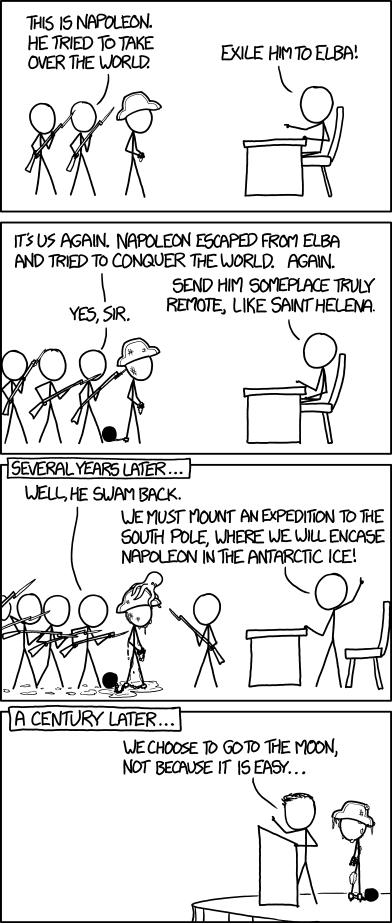
Makes as much sense as “…because it is hard.”
If you focus on the muscle, the fat will come off naturally.
…clearly, the people who instigated today’s parade of falsehoods at Entertainment Weekly were not eager for reconciliation. This was straight-up character assassination. A slash-and-burn hit job. Aided and abetted by media devices which are programmed to seek and spread controversy, for the sake of clicks, likes, and money.
Is Sad Puppies 3 a terrible thing? It is if you ask the opponents of same.
Is Sad Puppies 3 hateful to women or ethnic minorities?
Only if you believe Sad Puppies 3 participants like Annie Bellet or Rajnar Vajra don’t count.
I think perhaps what some people (unused to the insider baseball of SF/F) might not be clear about, is that Sad Puppies 3 is not a thing invented to keep anyone off the Hugo ballot for demographic reasons. It was invented to (originally) poke fun at some tired predictabilities in the selection process, as well as scuttle the notion that the award was actually all about quality, when it’s more or less been a popularity and quasi-politicized contest the whole time. Along the way we fairly skewered the concept of literary affirmative action — that works and authors should be judged on the basis of author or character demographics and box-checking, not the audience’s enjoyment of the prose — so perhaps that’s where opponents of SP3 thought they found a toe-hold? And used it as best as they could to rope in a lot of outside media, in a clownish attempt to punish and discredit both Larry and myself.
Obviously, anyone who tries to make a coherent case for me being racist or sexist . . . has over 21 years of contradictory evidence to overcome. You cannot have lived my life, and be a racist or a sexist. It is an ontological impossibility. I’ve seen too much of the elephant, to borrow a phrase. Plus, my wife probably would have thrown me out on my butt a long time ago — she being the far more astute judge of character, than either a low-rent tabloid blogger or a pernicious and vindictive SF/F personality.
And from Robert Tracinski: How to fight back in the culture war:
The other thing we’ve come to expect from the Social Justice Warriors is a bitter, dismissive hatred for the fans of their own field, who stubbornly refuse to be reformed by their betters. A rant from “progressive” writer Philip Sandifer, echoing last year’s proclamation that “Gamers Are Dead,” declared “The Day Fandom Ended.”
Sandifer argued for “the moral duty of progressive voices to form a blocking majority, and to loudly admit that fandom as it stands is broken, and that any work proclaimed to be the best of the year by a fandom this broken is demeaned by the association.” So he advocates that “progressives” should buy their way into the final ballot and vote for “No Award Given” in every category. “The 2015 Hugos should simply be blank.”
In other news, he’s going to take his ball and go home.
Not to be outdone, “Jeopardy Jerk“ Arthur Chu decided to live down to his epithet by denouncing “democracy” as such. It’s like Stalin said: the problem with elections is that you never know ahead of time who’s going to win.
Inherent in leftism is the notion that we all must be guided by a small elite, a revolutionary vanguard, and that if we resist our indoctrination, it is necessary to dissolve the people and elect another.
To be sure, it is possible some of the Sad Puppies nominees won because of their right-leaning politics rather than their quality. And it also appears that the proprietor of the competing slate, Rabid Puppies, has said a few genuinely objectionable things. But the science-fiction establishment might want to take a moment to ask how they have so alienated their core audience as to provoke this kind of mass protest vote. Than again, forget I said that. “Progressives” never ask that question. Inherent in leftism is the notion that we all must be guided by a small elite, a revolutionary vanguard, and that if we resist our indoctrination, it is necessary to dissolve the people and elect another.
I’d like to be a conscientious objector, but they won’t let me.
[Late-morning update]
It’s almost like they were all reading off the same script.
[Thursday-morning update]
The Social Justice Warriors aren’t so tough when even “sad puppies” can beat them.
[Bumped]
The impossibility of his physique. I’ve discussed this before (thirteen years ago. Yikes!). This piece seems to ignore the thermal issues. I don’t think just exhaling flames would be sufficient to get rid of the heat.
The ethics of dealing with astronauts’ bodies.
That’s not an issue I address in the book. Maybe I should.
…beclowns itself again on climate:
Well, their paragraph on Climate Science is a rather astonishing take on the APS Workshop. Their paragraph on Climate Change seems to come from the Guardian. Their statement on Climate Action reiterates their rather crazy statement in 2007
Apart from the issue that no one on the POPA seems to understand any of these issues beyond a superficial level (after Koonin and Rosner departed from the POPA), and that their statements are naive and unprofessional, here is my real problem with this. This is an egregious misuse of the expertise of the APS. Their alleged understanding of issues like spectroscopy and fluid dynamics are not of any direct relevance to the issues they write about in this statement. The statement is an embarrassment to the APS.
Either reform is required, or an alternate organization.
Forbes has a gallery.
Technically, of course, the balloon isn’t a “spaceship.”
As with any culture dominated by Leftists, it’s a chilling atmosphere.
What almost everyone one gets wrong about California’s water “problem.” But as is almost always the case, it also completely misses the point that there is no market for water here; it is allocated almost completely by politics.
[Update late morning]
Fight the drought: End recycling?
California is in a huge mess of its own making.
Kicking the can down it. Anyone who is waiting for NASA to send anyone to Mars is going to be very disappointed.