Why Obama is losing.
Shorter answer: he’s a political incompetent, with no discernible skills at anything other than winning elections. Ultimately, that may be the only thing that saves us from his destructive agenda.
Why Obama is losing.
Shorter answer: he’s a political incompetent, with no discernible skills at anything other than winning elections. Ultimately, that may be the only thing that saves us from his destructive agenda.
The New York Times discovers that he was as terrible a person as many (most?) of his acolytes.
I just got an email that NASA personnel are being evacuated from a brush fire south of the VAB on Merritt Island.
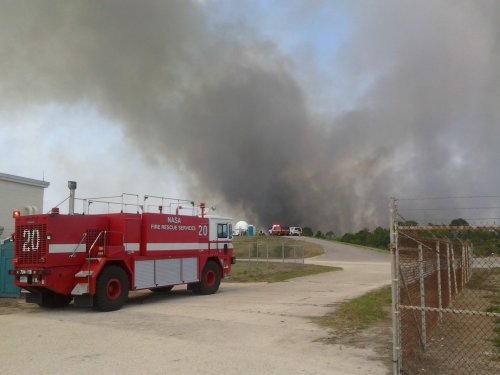
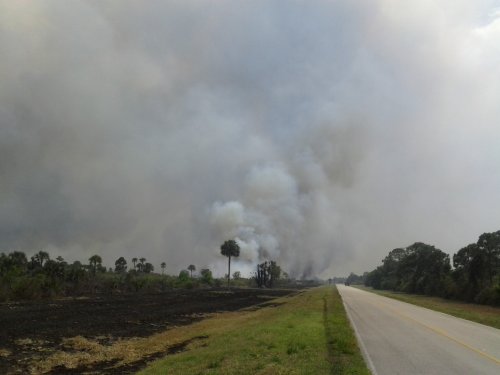
“Tel-4 road runs north/south for two miles then turns west for two miles until it hits the river. So if the fire jumps that E-W stretch of highway it is off KSC property and into civilian land. There’s a pretty respectable north wind today, so it’s a bit dicey until they get that back-burn done.
The second image is looking due south. So the VAB is to my back (to the north) about 6 miles. In that image, the land to the left is KSC property, the land on the right (about where the truck is down the road) is privately held.”
Is it possible? Even if it’s very unlikely, it’s such a high payoff that it’s worth devoting some resources to. In the mean time, I’m much more focused on making it affordable to just get into orbit.
“The bottom line: Most Americans would support an immigration reform plan, but only if border security comes first. And by “first” they mean before the legalization of currently illegal immigrants and before the creation of a path to citizenship. Would they be more flexible if they truly believed the federal government’s promise to secure the border? Perhaps — but they don’t believe.”
They’d be fools to. We know that the Democrats have absolutely no intention of closing the border. It’s the same kind of bait and switch that they pull with tax-rate increases and spending cuts. we get the higher rates, buy we never see the cuts.
…is just fine, “…as long as you’re a bigot in support of Democratic causes. Which, come to think of it, is how things were in Bull Connor’s day, too.”
I’m going to start calling them out on their racism at every opportunity. They’ve been doing it to me for years, and when I call them out on it, it will have the additional virtue of being actually true, and not just a dishonest Alinskyite tactic.
Some definitions you can use on April 1st.
…broken again. I’ve been too busy with the book to delve into the Marcott mess, but it seems to have imploded almost immediately upon publication, and Science (and “science”) haven’t exactly covered themselves in glory:
Let me be perfectly clear — I am accusing no one of scientific misconduct. The errors documented here could have been the product of group dynamics, institutional dysfunction, miscommunication, sloppiness or laziness (do note that misconduct can result absent explicit intent). However, what matters most now is how the relevant parties respond to the identification of a clear misrepresentation of a scientific paper by those who should not make such errors.
That response will say a lot about how this small but visible part of the climate community views the importance of scientific integrity.
Given the history, I’m not hopeful.
[Update a few minutes later]
More thoughts from Jonathan Adler:
No, this does not show that climate change is a scientific fraud. What it does show, however, is that some are willing to “sex up” climate science findings to feed sensational media coverage, and end up undermining confidence in climate science. Given that there is still much we do not know about climate change — including why mean global temperature has been flat for the past ten years — undermining confidence in climate science can (further) undermine its ability to inform policy. Climate science has taken some significant hits in the past few years. It doesn’t need any more.
At this point, it should be abundantly clear how foolish it would be to make major public-policy decisions on such “science.”
Ah, the utopian fantasies of the loony left:
Fittingly, the same day Egan’s hymn was published, the California State Auditor reported the state’s net worth – its assets minus its liabilities – at negative $127.2 billion. Also reported were $167.9 billion in long-term obligations, not including $60 billion in unfunded liabilities for retiree health care, or those for state employees’ future pensions. These are not just “bills.” These are benefits for public employees and services for the poor that won’t be delivered as promised.
California’s public school system, both one of the most expensive and one of the poorest performing in the country, is not improving. The state’s prison system is both so overcrowded and underfunded that the US Supreme Court deemed conditions “cruel and unusual punishment.” And despite 9.8 percent unemployment (tied for highest in the country), tax, regulatory, and zoning policies make blue-collar job creation in manufacturing and real estate development next to impossible.
But other than that, things are great.
Egan and other turquoise dreamers seem to look at tenured teachers, happy prison guards, and fleeced one-percenters and believe conditions are promising enough to move on to romantic dreams of the future. Over the heads of undereducated kids, the chronically unemployed, and the poor, they see a high-speed train zooming along the sparkling coast. This is not how progressives used to think.
What constitutes actual “progress” is, of course, subjective.
New York’s idiotic new gun law will be challenged in court:
Any Supreme Court action is years away, but many scholars think it’s inevitable in wake of two previous cases.
In the 2008 case of District of Columbia v. Heller, the high court for the first time established that the Second Amendment protects the individual right to bear arms.
And in McDonald v. Chicago of 2010, the justices ruled that the Second Amendment also applies to state and local gun laws.
For its part, the Cuomo administration says the SAFE Act will withstand its coming review in the federal courts.
“We believe that our law is sound and is immune from constitutional challenge,” said Richard Azzopardi, a spokesman for the governor. “Heller is the broadest reading of the Second Amendment that has ever come down, and the SAFE Act is consistent with that decision.”
Note that these are the same morons who restricted the use of guns to magazine capacities that didn’t exist, and forgot to exempt law enforcement from them.
Federal court decisions in the case will be “grounded on principles established by the Supreme Court over the last several years that seem to produce a robust set of problems for lots of aspects of the New York law,” said Nicholas A. Johnson, a Fordham University law professor and co-author of the book, “Firearms Law and the Second Amendment.”
Those problems go beyond the Second Amendment, Johnson noted.
The lawsuit filed in Buffalo challenges several provisions of the SAFE Act as being unconstitutionally vague, contending they conflict with the 14th Amendment’s guarantee of due process under the law.
For example, the law’s definition of assault weapons includes some guns that include a pistol grip “that protrudes conspicuously beneath the action of the weapon.”
Which raises the question: how big is a conspicuously protruding pistol grip?
It may be up to the courts to decide, which is nothing unusual. Johnson said gun-rights activists have been routinely challenging gun-control laws for 20 years on the grounds that their wording is too vague.
Such issues arise because of the “technically inept descriptions” of weapons in many gun control laws, Johnson added.
My emphasis. He’s being kind. For “technically inept” read “imbecilic.” In addition to the nonsensical “common-sense” phrase used by these people to describe their rapacity on our constitutional rights, the other phrase that they currently use in preference to the stupid “assault weapons” is “military-style weapons,” which “no one needs.” Unwittingly, they don’t even understand how that gives away the game on their stupidity in trying to outlaw commonly-used weapons for purely cosmetic reasons. It’s about “style,” don’t you see? It actually has nothing to do with actual function. They just want to outlaw the guns because they’re scary looking.
Anyway, they may end up regretting this if it results in the SCOTUS sweeping away much of their existing laws. But at least the law-abiding people in Washington DC and Chicago — and New York — will be safer once their draconian disarmament is off the books.