There’s been a lot of misreporting on this issue all week, that I’ve been admonishing people about on Twitter. Michael Listner explains the issue: No, the Outer Space Treaty does not prevent us from approaching water on Mars.
Category Archives: Space
NASA’s Bureaucracy
This comment over at NASA Watch is a pretty good description of the problem, on the 57th anniversary of the agency transforming from the NACA (which it needs to return to) to NASA:
In another current post on NW, Wayne Hale laments that the lengthy list of specifications is going to kill the commercial crew effort. Why this lengthy list of specs? Maybe because the NASA people who wrote the program requirements had no actual experience in developing any space hardware, and they did not know which specs to select, so they just included them all?
I should also note that it is not because more experienced and more qualified people were not available in these instances of program management, vehicle design, or spec writing. There were people with experience in Shuttle, Spacehab (commercial), Mir systems development, and with DOD programs, but the NASA management went with people they “knew” despite their lack of experience. You can look all the way to the top of the program, the AA for manned spaceflight, and he has little more experience, and so how can he provide the guidance for others to “learn the trade”. In fact he appears to have been responsible for naming a large number of his contemporaries, all from his old organization, payload operations, to leading positions. I don’t think they’ve worked out too well.
The mission ops directorate has the right idea-they require people to be certified and as they get certified their careers progress and they move from document writer to flight controller to flight director. The other technical/engineering disciplines do not have this and so we wound up in a situation where virtually anyone with a degree can be selected for almost any position.
Now, especially after 3 decades of ISS, you have the big bureaucracy in which the main experience base is in meeting attendance. And the people without the experience in the top positions are fearful of the people who actually have any education and experience. This is a corrupt bureaucracy.
That Wayne Hale post, from five years ago, is sadly prophetic.
To Mars Via The Moon
Charles Miller gave a FISO presentation today. I didn’t call in, but the MP3 seems to be available here.
I’m having trouble getting it to play, but you may have better luck.
Martian Brine
I haven’t had much to say about Monday’s “big” announcement, but Joel Achenbach has the straight scoop. In light of renewed concerns about planetary protection, from Emily Lakdawalla and others, I’m thinking about writing an op-ed on why we’re going to Mars, or sending humans into space at all.
[Update a couple minutes later]
I don’t know if I have the time or energy to properly fisk this right now, but Alana Massey says that sending humans to Mars is a terrible idea.
Blue Origin
The company announces that it’s completed a hundred successful tests of its staged-combustion turbomachinery. It’s a little misleading to show a full-engine test, with shock diamonds, though. Also, they don’t say if there have been any failures. Particularly of the rapid-unscheduled-disassembly type.
Meanwhile, Aerojet Rockedyne continues to beg for money.
[Update a few minutes later]
George Sowers just tweeted to me that these were subscale tests, not full scale. Hopefully, that’s next.
Another Review Of The Martian
From seed XCOR investor and blog reader Stephen Fleming, with connections to GA Tech.
[Wednesday-morning update]
Casey Stedman weighs in.
My biggest concern with going to the movie: When I read the book, I didn’t actually have to listen to the Disco.
[Bumped]
The FAA Learning Period
It was due to expire tomorrow. Congress just extended it for six months (assuming the president signs the bill, which he likely will).
Reportedly, this was to buy time to resolve differences between the House (who wants a ten-year extension) and the Senate (which wants five years) in conferencing the space bills in the coming weeks.
Filthy Meatbag Bodies On Mars
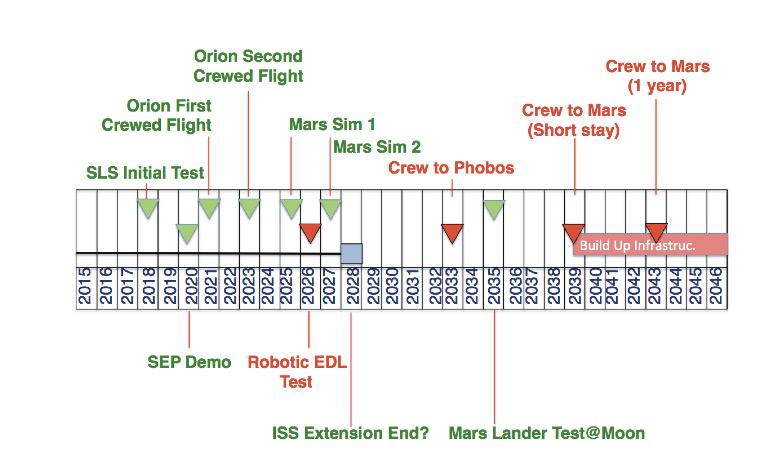
As Keith Cowing points out, the Planetary Society is in no hurry to put anyone on the surface of the Red Planet. They want to do Apollo to Mars, but take almost three and a half decades before the first boots on Mars, and almost four decades before long-term habitation. Though Firouz Naderi claims that keeping it under the cost limit makes it more likely, I’d say that it is doomed to failure. Something that takes that long, accomplishes so little, for so much money, is unsustainable in a democratic Republic. This is why Apollo to Mars is doomed in general. I’m discussing this in the Kickstarter project. We need to have a different approach, starting with an end to the phrase “space exploration” as the reason we send humans into space.
[Update a couple minutes later]
Here’s the link to the report. I’m reading it now, hoping it will have some useful cost data from Aerospace.
[Update a while later]
Even Chris Carberry recognizes that we won’t ever get another “Kennedy moment.” I’m not sure, though, how one “stays the course” to Mars, when there is no course.
[Late-morning update]
Over at Sarah Hoyt’s place NASA employee Les Johnson proposes (wait for it) Apollo to Mars.
It is not going to happen, and it should not happen.
This Weekend’s Super Lunar Eclipse
Unfortunately, looks like it’s only partial on the Left Coast.
The Golden Spike Company
Their domain has become available.
It could be that they simply forgot to renew, but this doesn’t seem like a good sign.