Gerst is showing this chart at the NAC meeting today.
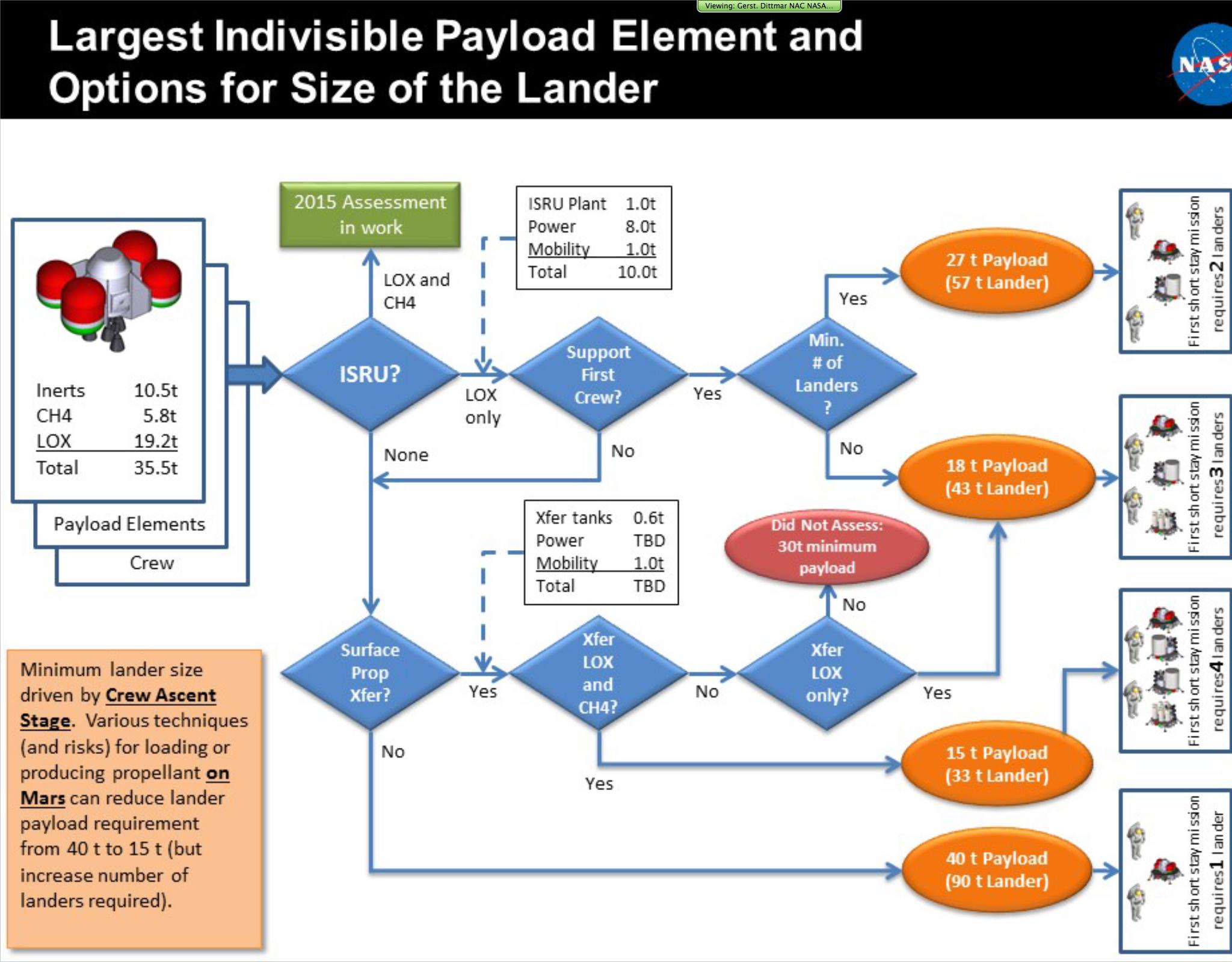
He’s saying he doesn’t have to make decisions about Phobos versus orbit versus surface until 2020.
[Update a couple minutes later]
Here are the solar electric options.
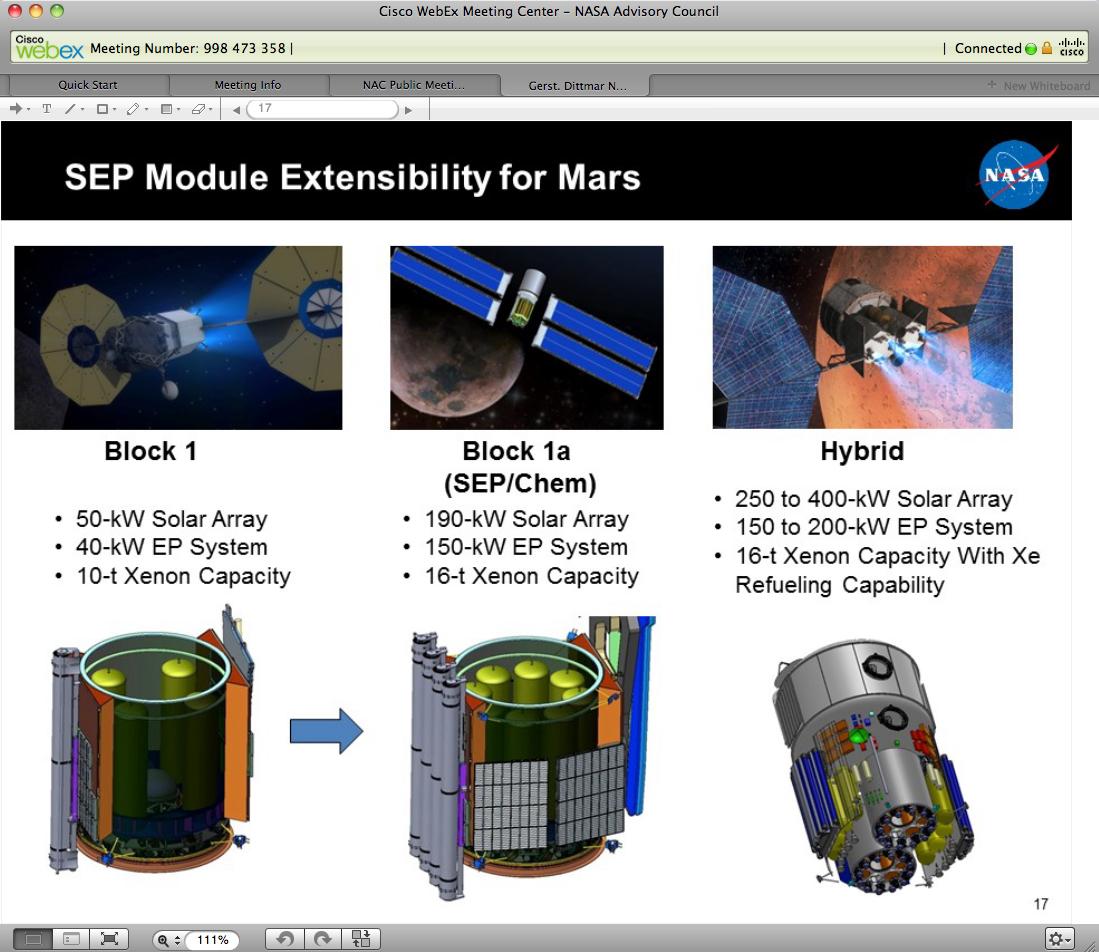
Gerst is showing this chart at the NAC meeting today.
He’s saying he doesn’t have to make decisions about Phobos versus orbit versus surface until 2020.
[Update a couple minutes later]
Here are the solar electric options.
Jeff Foust has the story from yesterday’s NASA Advisory Council meeting on the issues.
[Update a few minutes later]
Congress: "Comm Crew behind schedule, cut the budget!' "SLS/Orion behind schedule, increase the budget!" http://t.co/hsyGdq7uxi
— Rand Simberg (@Rand_Simberg) July 29, 2015
I missed this on Monday, but Jeff Foust has a report on last week’s announcement. A lot of comments there, including the usual ignorance from Marcel Williams.
Spaceflight Now has the video released by the NTSB.
[Update a while later]
Wayne Hale: Pilot error is never the root cause.
[Afternoon update]
Dough Messier has broken down the crucial seconds frame by frame.
I’m going to switch from listening to NTSB meeting to hear the status on exploration systems at 9 AM PDT. Phil McAlister will be discussing Commercial Crew status later this morning. I would note that in this morning’s meeting in the House, Chairman Culberson was very enthusiastic (as expected) about the Europa mission, but he still insanely imagines that SLS is the solution to it.
I’m listening in live now, but Leonard David already has a story up.
[Update a few minutes later]
Doug Messier has the executive summary. Full report won’t be available for a couple weeks.
[Update a while later]
Temporary adjournment to wordsmith final findings. Sumwalt wants to make clear that while it was pilot error (Finding 1), it was an institutional failure at Scaled that made it possible for such an error to be catastrophic. There also seems to be some (IMO, undue) criticism of FAA-AST, and talk of “political pressure” to prematurely issue licenses/waivers. People (including NTSB) need to understand that AST currently has no statutory authority to regulate safety of the spaceflight participants, including crew, and they are chronically under-resourced to carry out the responsibilities that they are authorized to do. In fact, George should be careful what he wishes for, because if the learning period expires this fall, he still won’t have the budget he needs to expand his authority.
One thing that’s not clear yet (to me): If part of the problem was inability to read instruments due to vibration under thrust. If there was a digital readout, that (and other critical information) should be replaced with an actual Mach meter.
[Late-afternoon update]
Here‘s Jeff Foust’s report.
I’ve been on a telecon all day on the NASA Advisory Council meeting at JPL. Some very interesting discussion on launch and technology issues. I’m generally impressed with the tech plans, except for the absence of serious ISRU.
While this is a good general topic, nowhere is it more true than in human spaceflight:
Sometimes the new competition wins anyway. Uber has been good at generating a large base of mobile customers, then using them to pressure politicians: When New York City Mayor Bill de Blasio went after Uber, Uber used its app to let its users pressure de Blasio.
Happy Uber customer Kate Upton weighed in, producing more pushback than de Blasio could withstand — especially when it turned out he’d gotten over $550,000 in donations from taxicab interests.
Other services aren’t so lucky, and the ability to do an end run around regulators, though welcome, isn’t universal. And if, on top of setting up your lemonade stand, you need licenses, permits, lobbyists and subsidies to make it, not many new lemonade stands will get started. That’s good news for existing lemonade stands, and for the politicians they support, but it’s bad news for everyone else.
Including people who actually want to affordably accomplish things in space.
Stephen Smith has some for the presidential candidates:
U.S. Census statistics show that more people alive now were born after Apollo (185 million) than before (123 million). For the majority of the population, the 1960s Space Age is a page in a history book, and has little personal emotional resonance.
So do yourself and the nation a favor. Don’t invoke Kennedy.
As your campaign staff develops its space policy white paper, begin with a fundamental question — why should people be in space?
Yes.
First (as he told me last week he planned to do), Charles Miller rolled out his proposal for a return to the moon, using commercial launchers, at the National Press Club. I haven’t read it yet, but I’m sure it will contain a lot of good info to inform my own project.
Second, Elon had a press telecon to present preliminary findings on the accident. It was apparently a broken strut on the helium tank in the LOX tank, which failed at 20% of the rated strength (it seems to have failed in tension). Return to flight no sooner than September, depending on customer willingness to fly, redesign of strut (and new supplier). Falcon Heavy first flight delayed until Q2 next year. He admitted that it may have occurred due to “complacency” after long string of successful flights. Most current employees had never seen a failure.
[Update a few minutes later]
Alan Boyle (who seems to have retired from NBC, congratulations) has the story at Geekwire.
[Tuesday-morning update]
Here’s a description of what went wrong from the Space Access Society.
[Update a few minutes later]
Here’s Stephen Clark’s takehttp://spaceflightnow.com/2015/07/20/support-strut-probable-cause-of-falcon-9-failure/ over at SpaceflightNow.