Simply put, the SLS program should be canceled now to free up approximately $10 billion programmed for this decade. This money could then be redirected to continue the planned flight tests of the Orion spacecraft with the much lower-cost Falcon Heavy booster while making a robust investment in a first-generation space station in the vicinity of the Moon. An investment in such a cislunar station would provide—by the early 2020s—a multifunctional platform to act as a fuel depot, a workstation for robotic operations on the Moon and a habitat to protect against the more intense radiation environment outside of the Earth’s magnetic field. This station could even be used as a habitat during longer-duration human missions to an asteroid and eventually to Mars.
Expect to see a lot more editorials like this as time goes on, new systems appear, and budgets get tighter.
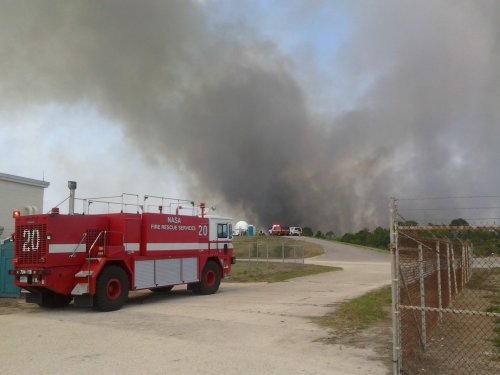
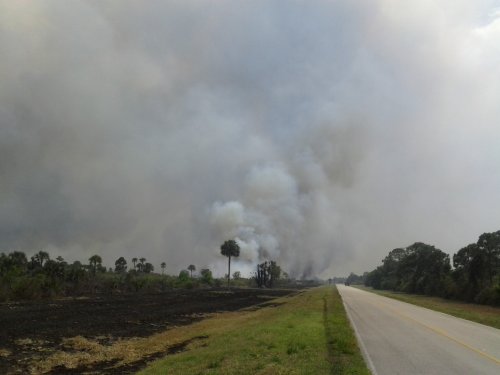
I just got an email that NASA personnel are being evacuated from a brush fire south of the VAB on Merritt Island.
“Tel-4 road runs north/south for two miles then turns west for two miles until it hits the river. So if the fire jumps that E-W stretch of highway it is off KSC property and into civilian land. There’s a pretty respectable north wind today, so it’s a bit dicey until they get that back-burn done.
The second image is looking due south. So the VAB is to my back (to the north) about 6 miles. In that image, the land to the left is KSC property, the land on the right (about where the truck is down the road) is privately held.”
Is it possible? Even if it’s very unlikely, it’s such a high payoff that it’s worth devoting some resources to. In the mean time, I’m much more focused on making it affordable to just get into orbit.
A source who (for obvious reasons) wants to remain anonymous informs me that 45th Space Wing at Patrick is starting to cut back on maintenance and operations of range safety at the Cape through the end of the (fiscal) year.
I’ll bet I could find other places to cut that wouldn’t impact commercial launches, but the administration’s goal remains to inflict the maximum amount of pain. I should note that apparently the layoffs will start in the next couple weeks. Whether or not they’ll be able to get those people back in October is an interesting question.
This isn’t really satisfactory, though, without quantifying it:
So are asteroids celestial bodies like the moon? Or something different? A number of space-law scholars have weighed in recently. The bottom-line argument is, as Andrew Tingkang noted in a Seattle University Law Review article, that if you can move it, it isn’t a celestial body.
We see a similar distinction on Earth between “real” and “personal” property. Real estate is land. One of its chief characteristics is that it stays put. Personal property can be huge—a supertanker or a 747—but it’s movable. The rules relating to real property are different, and usually more stringent, than the rules relating to personal property. Land is accounted for by deeds and registries; for personal property, possession is enough to establish a presumption of ownership.
The biggest asteroids, like Ceres or Vesta, are probably too big to move, so even though they’re smaller than the moon, they might count as celestial bodies. But a 100-meter class-M asteroid is readily movable. It’s not real estate; it’s just a rock.
Anything, including the moon, can be moved. It’s just a matter of degree. When we slammed LCROSS into it a while back, we moved it, though probably not measurably. One clear-cut definition could be if you change the body around which it’s orbiting.