…for electric cars? This could be a game changer, if it’s for real.
Category Archives: Technology and Society
About That Coronal Mass Ejection
I was curious as to the effect that yesterday’s event will have on the space weather, so I asked my space weathergirl buddy, solar physicist Dr. Barbara J. Thompson at Goddard. She wrote:
There are three major effects from solar “events” – light from flares, magnetic field & mass from eruptions, and energetic particles (ions and electrons) that can be caused by both flares and eruptions (also called coronal mass ejections or CMEs). These three broad classes are monitored because of the effects they have – see the table at the bottom of this page.
The above image shows the alerts that resulted from the eruption/flare – taken from this page at NOAA’s web site.
In general, flares cause radio interference, CMEs cause geomagnetic storms, and energetic particles cause radiation hazards. However, it’s a complicated system and there are always exceptions to any generalization!
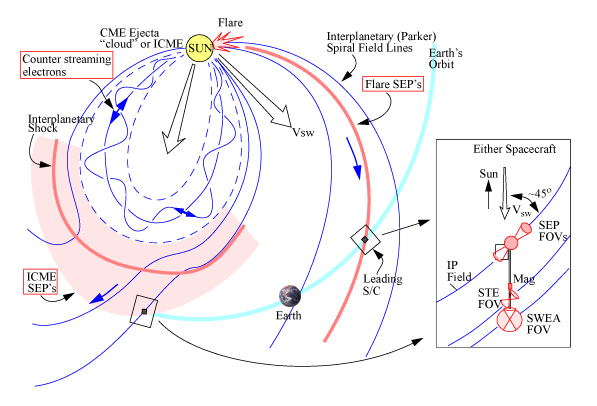
The three different types of phenomena have different ways that they reach Earth. There’s a great explanation here and they have the following diagram:
In the diagram above, the flare is occurring on the Sun at a location where it can be seen from Earth, and the light from the flare takes 8 minutes to reach Earth. The flare yesterday was an M-class flare, which is large but not as large as an X-flare (which is ten times larger), but it had enough strength to have some impact.
The CME (eruption of magnetic field & mass) takes 1-5 days to reach Earth’s orbit, depending on how fast it’s going (1 day is *extremely* unusual). In the figure, the CME isn’t heading towards Earth. However, the forecasts are difficult if the CME isn’t going straight towards Earth. It you look at the diagram above, the CME isn’t hitting Earth. However, what if the CME expanded just a couple of degrees wider than the forecast? The Earth could get a glancing blow from the CME – it could either be hit by the CME itself or by the compressed or shocked fields lines near the CME (shown at the large pink region). Glancing blows are really hard to forecast. Yesterday’s event was opposite of the diagram – the CME was to the right of the Earth instead of the left, but it still was far enough away that anything more than a glancing blow is unlikely. Yesterday’s forecast model is here.
So, the flare’s already finished, and the CME is unlikely to hit us. That leaves energetic particles, which can reach Earth in as little as half an hour after a flare, but can happen for days an eruption. The diagram shows the two sources of the energetic particles — flares and the shock from a CME (note: CMEs don’t always have shocks, it depends on their interaction with the solar wind). The energetic particles move (primarily) along magnetic field lines, and the solar wind makes a spiral shape. Where the Earth crosses the spiral determines whether particles will reach Earth. In the diagram, none of the field lines from the CME’s shock are connected to Earth, but the flare’s SEP might (the red line with the two blue lines around it show the estimated location of the solar wind magnetic field lines. Since yesterday’s CME happened to the right of Earth’s orbit (instead of to the left, as in the diagram), the solar wind field lines were very closely connected to Earth.
The alerts timeline shown above does indicate that there’s an elevated chance of energetic particles continuing through tomorrow.

So, bottom line, probably no biggie for us, though someone in transit to another planet might have to hit the storm shelter. There’s more info over at Space Weather, where they’re predicting a greater-than-25% chance of geomagnetic storms tomorrow.
[Update a little while later]
Barbara has a lot more here, including a cleaned-up version of this explanation (which was an email), though I don’t see much of anything wrong with it.
Growing The Energy Supply
It comes from markets, not bureaucrats:
There is a lesson here for public policy generally, including health care. No centralized government expert predicted the vast expansion in energy supply from hydraulic fracking. It was produced by decentralized specialists in firms subject to market competition.
Just as Friedrich Hayek taught, no central planner can know or foresee enough to produce the beneficial results regularly produced by competition in free markets regulated in accordance with the rule of law. And no central planner can accurately predict the course of innovation that can be achieved in decentralized markets. That’s something you might want to keep in mind when someone tells you that Medicare costs can be controlled by 15 members of an unelected board created by Obamacare. Better results and lower costs can be expected with the kind of market competition set up by the 2003 Medicare prescription drug law.
We can’t get rid of these unjustifiably arrogant ignorami soon enough. But it’s less than a year and a half to judgment day.
Better Hamburgers
…through science. If I had some liquid nitrogen, I’d give it a try.
I wish more people would read and follow this how to. Though I still think that top posting is wrong under most circumstances. I’m just old fashioned that way, from the days before AOL and Microsoft ruined email.
Weinergate
…and the Twitter numbers. It’s OK, though — he’s a “liberal” Democrat.
[Update Monday morning]
“I demand an official investigation of the hacker who broke into Congressman Weiner’s Twitter account.” Me too. It’s an outrage.
[Update a couple hours later]
Mickey Kaus agrees with Jim Treacher and me:
So a liberal Congressman basically stands accused of sending a highly inappropiate tweet, while a right-wing blogger basically stands accused of setting him up. They could both be innocent, of course. Or not. But this isn’t a case of he said/he said. There are electronic records of all these actions. If both of the accused open up their computers to a neutral, third party tech nerd–-who doesn’t have to be in law enforcement–-it should be possible to find out fairly quickly if either/both/none of them is culpable, no? The truth is in there!
I wonder if the congressman can handle the truth?
[Tuesday evening update]
The Democrats are circling the wagons, as they always do.
A Posting From Bizarro World
So I was reading comments at Paul Spudis’s Apollo anniversary post, and I saw a trackback to this:
As we contend there, if we can put a male on a moon, because can’t we get people to stop creation bad analogies with putting group on a moon? But on this anniversary, a some-more touching defence is, if we can put a male on a moon, because can’t we put a male on a moon? We did, after all, have a devise to do so until Constellation was canceled final year. But there was a good reason it died — it was an try to repeat Apollo (quite literally — NASA director Mike Griffin described it as “Apollo on steroids” when he rolled it out over 5 years ago– a word he no doubt came to regret). The problem was, it was function though possibly a coercion or the bill of that project. As heavenly scientist Paul Spudis points out during Smithsonian Air and Space magazine, a genuine problem is that we have never figured out as a republic because we have a space program.
It’s as though someone took my anniversary piece and put it through a word blender. Does anyone have any idea what’s going on here?
Writing Unmaintainable Code
An extensive guide. He clearly put a lot of work into it.
[Via (who else?) Geek Press]
So Much For That Excuse
The EPA administrator admits that fracking is not a threat to groundwater.
I think that natural gas is going to get very cheap, and here in California, I expect electricity prices to continue to go crazy, particularly with the batshit new carbon law. Probably time to invest in a gas heater for the spa. I think it would pay for itself in a year. In fact, I might look into a gas generator, and not just for emergencies. I’ll probably have to hide it from the carbon police, though.
The Manhattan Project
….was it a fluke?
I think there are some category errors here:
In the vast majority of mechanical inventions, there have been thousands of trials at a component level, hundreds of partial (e.g. static tests of a rocket in which the engine is run but the rocket is not actually flown) or complete trials of a full system. It usually involves many attempts before a full system such as an atomic bomb actually works. Mechanical inventions that work right the first time are clearly the exception in the history of invention and discovery. Some possible exceptions are Tesla’s alternating current motor (if Tesla is to be believed), the atomic bomb, and the first flight of the Space Shuttle. Inventions that work right the first time do appear to occur, but they are rare, exceptions, outliers, flukes. They probably should not be treated as typical or likely for planning purposes or investment decisions.
…projects that succeed on essentially the first attempt are rare; in this, the Manhattan Project is quite unusual. Yet, this success of the Manhattan Project has greatly helped fund scientific R&D megaprojects that implicitly assume that the full system will work on the first try or with only a few attempts, something that is historically rare. Full scale systems like the ITER tokamak, particle accelerators like the Large Hadron Collider (LHC), and so forth are both extremely expensive and each trial of the full system is likely to cost anywhere from millions to billions of dollars. Thus, one hundred full system trials, perhaps a more realistic planning number, implies vast costs. Not surprisingly, many scientific megaprojects like the NASA Ares/Constellation program recently or the Super Conducting Supercollider (SSC) have foundered in a sea of rising costs.
Ignoring the fact that Constellation wasn’t a “science” project, one of these things is not like the other. Rocketry isn’t really rocket science any more. If you consider Falcon 1 a “training rocket” for SpaceX, consider that Falcon 9 worked almost without a hitch the first time (the only issue was the upper-stage roll), and Dragon worked the first time. If you do enough simulations, it is in fact possible to get it right the first time (though Shuttle had a pretty bad first flight — I’ve learned recently that Young and Crippen actuallywould have considered ejecting due to concern about the body flap damage from overpressure, had they known about it). The problem with vertical takeoff expendable rockets is that they pretty much have to work the first time, or at least in as few a number of tries as possible, because tests are expensive, and they’re not possible to incrementally test. I can’t emphasize enough what a breakthrough the new reusable suborbital vehicles are going to be, in their ability to incrementally test and do gradual envelope expansion. But in the context of incremental development and testing, I’m not sure what “work the first time” even means.
I would also note that Constellation’s problems were cooked in from the beginning, given what an awful design concept, and incompetent management it had. Combine that with the pork aspects, and its failure was inevitable, as many (including me) predicted at the time.
Anyway, despite the mixing of apples and oranges, it’s an interesting, albeit long, read.