Scolding never works. But it’s what you’d expect from an economic ignoramus like Barack Obama. And yes, Jerry Ford was, too.
“That’s What Socialized Medicine Does”
“…it turns each of us into a little fascist.” Of course, a lot of people, far too many, don’t mind that. They don’t mind it at all.
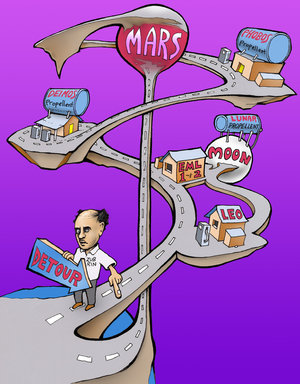
Zubrin’s Path
An amusing political cartoon, but pretty much inside baseball for space enthusiasts.
In Which I Agree With Nancy Pelosi
“If you are asking me personally, I have not been a big fan of manned expeditions to outer space in terms of safety and cost. But people could make the case – technology is always changing … and that could change depending on the technology,” she said today in a press conference with regional reporters.
I don’t think that safety is that big an issue, though apparently the body politic insists that it is (which is why we make so little progress in opening the frontier). But she’s dead on. The current plan makes no fiscal sense whatsoever, but with a change in technology (e.g., orbital infrastructure), it could be improved dramatically. Of course, it would also involve not just a change in technology, but more importantly, a change in philosophy, from a government command-and-control space program to one much more attuned to market incentives and private initiative. Somehow, I suspect that Nancy will be much less interested in that…
Anyway, it’s a shame that the Augustine panel couldn’t put a stake through the heart of the money-sucking heavy-lift myth. But I’d be happy to attempt to persuade Madam Speaker (assuming that she’s sincere…OK…OK……..OK…………OK, you can stop laughing now) that there are better ways to go.
Science, Epistomology…
…and science reporting. An interesting post by Derb:
…science has more epistemic depth than most of us can cope with. That water quenches thirst and puts out fires, I can confirm by experience. That it is composed of hydrogen molecules bonded to oxygen molecules by electromagnetic forces, I take on trust. “What the deuce is it to me?” I take it on trust because water’s real useful (see above). I’d likely be skeptical about the hydrogen/oxygen business if it were detached from the thirst-quenching and fire-extinguishing. It sounds improbable on the face of it, and one can easily think up folkish objections, of the kind that creationists make against evolution. (Hydrogen’s highly flammable. If there’s hydrogen in water, why isn’t water flammable? Etc., etc.)
When unmoored from utility, abstract ideas have to appeal to the human mind on their merits; and the human mind is so structured that the only abstract ideas it regards as having merit are those that concord with the “naïve duality” that is our default metaphysic — “medium-sized dry goods” being acted on by human wills, or by invisible spirits possessed of human-like wills. That’s as much epistemic depth as most of us can handle. Abstract ideas at odds with that schema just irritate us. And of course, an abstract idea widely held among people we dislike for personal, social, or tribal reasons, is doubly unappealing.
When the science has as powerful real-world implications as climate “science” (sorry, it’s hard to say it without scare quotes at this point) does, it must be trusted much more than it currently deserves to be, based on the behavior of its ostensible practioners.
Thoughts On Judicial Supremacy
Ramesh discusses something that doesn’t get enough discussion:
The argument that has not been made (or at least not made often) is that the whole legislation — not just the individual mandate — exceeds the constitutional powers of the federal government. This classic conservative position has gone unvoiced. I suspect that it has done so because, again, of the influence of judicial supremacy. We have been trained to think that saying that an overhaul of American health care exceeds the legitimate powers of Congress is equivalent to calling for the judicial invalidation of health-care legislation (along with much of modern government, by implication). Since that would be absurd to call for, we don’t say it.
At the risk of being thought quixotic, let me suggest that we need to revive a dormant tradition of legislative reasoning and argument about the Constitution. In this kind of constitutional reasoning considerations that it would be improper for judges to invoke have their place.
What a concept. This is annoying, too:
…too many commentators have dwelt on the question of how the courts are likely to treat the legislation — or, at best, what they should do consistent with their precedents — rather than on the distinct question of whether the Constitution, properly interpreted, grants Congress the power to enact this legislation.
It’s partly because many of the commentariat don’t even understand the Constitution, nor care about it much, at least when it comes to the government running the economy. But it’s also a symptom of the simple-mindedness of the media. It’s like a political campaign where they report on the horse race — who’s ahead or behind — rather than what the candidates actually say about the issues, with an analysis of it. Yes, it’s not unimportant to speculate about how a court will rule, but it’s not as important as analyzing the actual legal and constitutional issues, but they’re either incapable of that, or uninterested.
Give Them Amnesty
This is pretty funny:
How can anyone be mad at them just because thet crossed over some arbitrary border? They were only doing things that regularly invited guests didn’t want to do, like hang out with Vice President Biden. How can the White House punish these poor, oppressed, undocumented visitors?
They’re just xenophobes. And (of course!) racists.
No Lunar Landings For The Indians
At least no time soon, or affordably:
Theo Pirard, who attended the conference, discovered the projected plan of the Indian manned Mission on the Moon, which is the result of recent feasibility studies made by ISRO. This plan offers some similarities with the US Constellation programme for the return to the Moon but no date could be announced, because of lack of money.
Yes, the main similarity is that they think that in order to go to the moon, you have to replicate Apollo. We’ll see how these long-term plans evolve in the years to come when the reusables start flying, and Bigelow is doing lunar excursion using depots.
How Technology Will Change Our Lives
…in the next decade. Prognostications from Ray Kurzweil. This is the part I like:
We won’t just be able to lengthen our lives; we’ll be able to improve our lifestyles. By 2020, we will be testing drugs that will turn off the fat insulin receptor gene that tells our fat cells to hold on to every calorie. Holding on to every calorie was a good idea thousands of years ago when our genes evolved in the first place. Today it underlies an epidemic of obesity. By 2030, we will have made major strides in our ability to remain alive and healthy – and young – for very long periods of time. At that time, we’ll be adding more than a year every year to our remaining life expectancy, so the sands of time will start running in instead of running out.
For those of us interested in space, we’re going to need it, because one thing that doesn’t seem to be improving over time is government space policy.
Avoiding Tickets
Drive one of these cars. This would be more interesting if there were some theoretical basis as to why they’re less ticket bait than others, as opposed to (I assume) empirical data. It’s not clear what else they have in common.
My theory of ticket avoidance is a) don’t drive a red car — they stand out and look fast even sitting still and b) don’t cruise the left lane on the freeway — that’s where cops are looking for speeders. I’ll never rent a red car if I can avoid it. I rarely drive below the speed limit, and I get a speeding ticket about twice per decade or so (a rare enough event that it has no effect on my insurance rates, let alone my driving privileges).
I recall back in the early nineties, when a well-known space activist (who will remain nameless to prevent embarrassment) and I were driving from DC up to Princeton for Gerry O’Neill’s funeral in his rental. We were going through Maryland, which is renowned for speed traps, and I warned him to use the left lane for passing only, but he didn’t heed me, and blithely cruised in it, until he heard the sirens behind him. And while we were pulled over, yet another well-known space activist passed us, saw who was sitting in the driver’s seat, and laughed.
And this all confirmed my theory, sort of, at least to me. I’ve only gotten two speeding tickets on a freeway in my entire life — all the others have been on open two-lanes, or passing through towns and not slowing down enough.